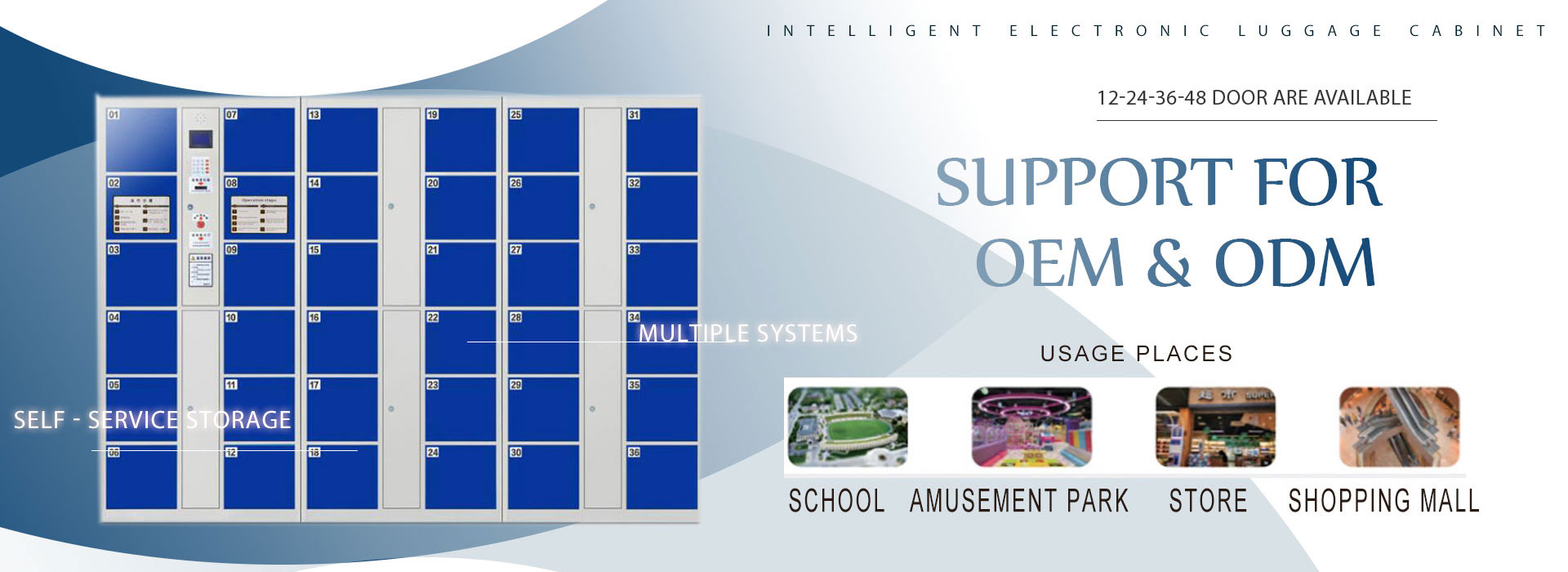
Every proposal for self-service lockers in a public building carries the same sentence: this will cut waiting time. Nobody ever puts a number next to it, which is why the sentence survives committee meetings and then fails quietly in service.
There are four numbers that decide whether it is true, and all four can be measured on your own site in under a week. Two of them are usually better than expected. Two are usually worse, and one of those has nothing to do with the cabinet.
1. Throughput at the peak hour
Not daily footfall. The number of people who can complete a deposit or a collection in the busiest sixty minutes.
The arithmetic ceiling is set by occupancy, not by how fast the screen is: with twelve doors and an average stay of forty-five minutes, the bank turns over twelve × (60 ÷ 45) ≈ 16 uses an hour. Real figures land lower, because two people arrive together and one waits.
How to measure it. Stand at the cabinet for the busiest hour on your busiest day and count completed transactions, not people. If a colleague can count for you, count refusals too — people who walked up, looked at it and left. That second number is the honest one.
What good looks like. More than 30 completed uses an hour on a twelve-door bank is a bank that is too small, not a bank that is working. Under 8 means the cabinet is in the wrong place and the throughput argument is irrelevant until that is fixed.
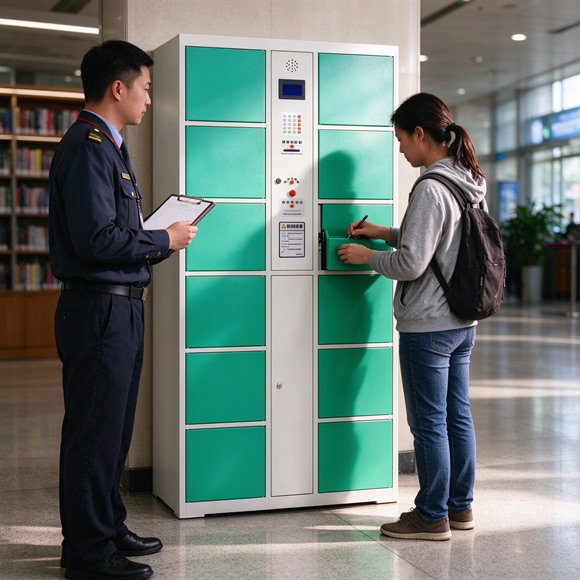
2. Staff minutes per hundred uses
This is the number the business case rests on, and it is the easiest to obtain because someone already keeps the rota.
A staffed cloakroom spends roughly 45 seconds per direction: taking the coat, issuing a tag, and the same in reverse. A hundred uses is two hundred directions, about 150 minutes. A locker bank spends most of that on nothing, and the residue is real: helping someone who cannot read the screen, resetting a forgotten code, dealing with a jammed door. Budget 5 to 10 minutes per hundred uses and you will not be far out.
How to measure it. Ask the desk to tally, for three days, every minute spent on storage that is not a sale. Do not ask them to estimate; ask for ticks on a sheet. Estimates from memory come back one third of the real figure, in either direction depending on who is asking.
What good looks like. The honest target is not zero. A bank with no staff attention at all is usually a bank where nobody helps, and the people who needed help stop using it.
3. Doors per square metre of floor
Space is the argument that wins in buildings where the queue is not the problem and the floor area is.
A twelve-door body stands 1800 mm tall, 850 mm wide and 460 mm deep, so it takes 0.39 m² of floor and provides twelve compartments: about 30 doors per square metre. A staffed cloakroom with a counter, a rail and a queue lane needs six to eight square metres for a hundred hooks, which is closer to 14 per square metre.
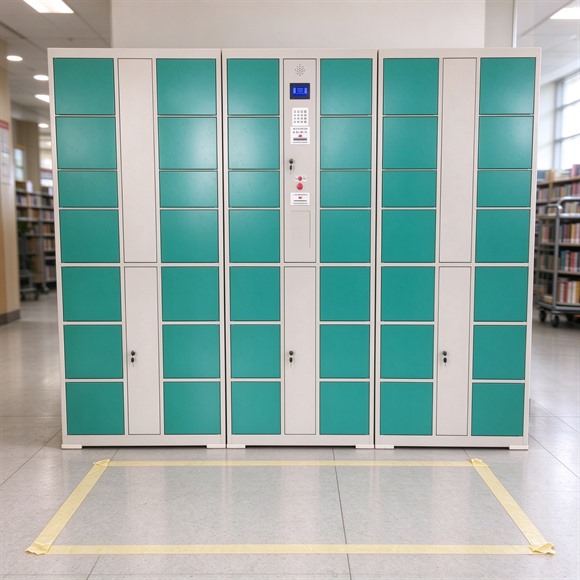
How to measure it. Tape the outline on the floor for a week. Not the cabinet footprint — the footprint plus the space a person needs to stand in front of an open door. Four hundred and sixty millimetres of depth becomes about one metre of usable floor once somebody is standing there, and that is the figure that decides whether the corridor still works.
What good looks like. If the taped outline blocks a fire route or a trolley run, the density is irrelevant. A dense bank in a place people cannot stand is a wall.
4. Time from “it will not open” to a door that opens
This is the number that decides whether the project is judged a success, and it is decided by your staffing model rather than by the product.
Three scenarios, same cabinet:
| Situation | Realistic time | What it feels like to the user |
| Staff on site, mechanical key available | 3 to 5 minutes | An inconvenience |
| Staff on another floor, called by radio | 15 to 25 minutes | A complaint |
| Nobody on site, number goes to voicemail | 40 minutes plus | A review, and a request for a refund |
How to measure it. Do not measure it. Rehearse it. Pick a quiet Tuesday, have somebody report a stuck door through the real channel, and time it end to end. What you learn is whether the override process exists at all, which no amount of product specification will tell you.
What good looks like. Under five minutes, with two named people able to do it, and a log that records who opened what. If only one person holds the key, the real number is however long it takes that person to come back from leave.
What the four numbers do not capture
Two things, and they are worth saying out loud because they are the usual reason a technically successful installation still gets removed.
The first is whether people use it. A bank that is 20% occupied after a month is not inefficient; it is invisible, or it is in the wrong corridor, or nobody explained what it is for. Counting occupancy at week four tells you more than any of the four metrics above.
The second is whether the alternative was ever really staffed. Several projects compare a self-service bank against a cloakroom that was only open three hours a day, and conclude a large saving that was never actually being spent.
What to do with the numbers once you have them
Four figures on a sheet are not a decision. These are the rules worth applying to them, in order.
- If number 4 is over fifteen minutes, stop. Buying a cabinet does not fix a reporting process. Sort out who can open a door first, then come back to the specification.
- If number 1 is over thirty uses an hour, add doors or add a second position. A queue at the printer is not a screen-speed problem and no firmware update will clear it.
- If number 2 is under thirty staff minutes per hundred uses, the labour case is weak. At that level the cloakroom was already cheap to run, and the honest justification becomes user convenience rather than headcount.
- If number 3 blocks a route, move the bank. Density is only an argument while people can stand in front of an open door.
Apply them in that order, because each one can end the conversation before the next. Most projects that go wrong skip straight to the third and argue about price.
One week, one sheet
| Day | What to do | What you get |
| Monday | Tape the footprint on the floor, including standing room | Number 3, and an argument about corridors |
| Tuesday | Rehearse a stuck door through the real reporting channel | Number 4, and the truth about the process |
| Wednesday to Friday | Tick sheet at the desk for every storage minute | Number 2 |
| Saturday | Count completed uses in the busiest hour, plus refusals | Number 1 |
| Week four | Walk past and count occupied doors | Whether any of it is being used |
Five days of counting beats another round of proposals, and it costs one sheet of paper and somebody’s attention on a Saturday morning. If the four numbers come back favourable, the case writes itself. If they do not, you have saved a capital project — which is also a result.
The door-count side of that arithmetic is set out in the electronic locker range, and if the building is deciding between cards and printed tickets, card-operated lockers covers the trade-off.
The alternative approach to the same problem is set out in 36-door barcode electronic lockers.