At 5:40 on a Friday the phones are already lined up along the top of the staff wardrobe — eight of them, face up, one buzzing against the chipboard. Service starts in twenty minutes. By half past six two will be in somebody’s back pocket, because there was nowhere to put them, and the rule about phones on the floor will have lasted exactly one shift.
A cabinet does not fix that on its own. It gives the rule somewhere to happen: a door closes, the phone stays behind, the person walks onto the floor without it. Small physical change, large effect on a shift — but only in the right building.
Three cases where you should not buy one
| Ten staff on shift, phones never go missing, nobody is on the floor with one | A lockable drawer in the office does the same job for nothing. Come back when headcount doubles. |
| The problem is phones at the pass, not phones going missing | The cabinet supports a rule, it does not replace one. A cabinet nobody is asked to use becomes a shelf within a month. |
| You want guests to charge phones while they eat | Different product. Guest units face spilled drinks and no supervision; staff units belong at the back of house. |
What the cabinet actually does
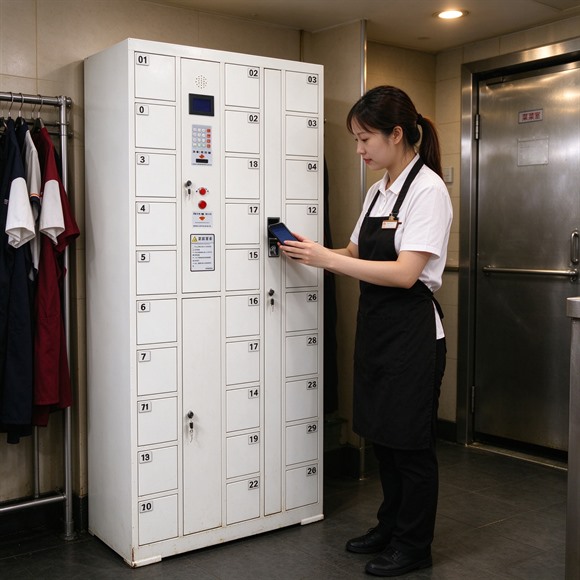
One compartment per person. The phone goes in at clock-in, comes out at clock-out, and comes out charged. Four details only make themselves known after the first week:
- Four lock types on one body — mechanical key, keypad code, card, fingerprint. Fixed brigades take keys; front of house with student turnover does better on codes, because there is no key to lose and no lock to drill.
- A card slot on every door for a name card or numbered tag, so nobody tapes labels on.
- An optional timer switch that cuts power outside the prep window, so nothing charges from midnight to noon.
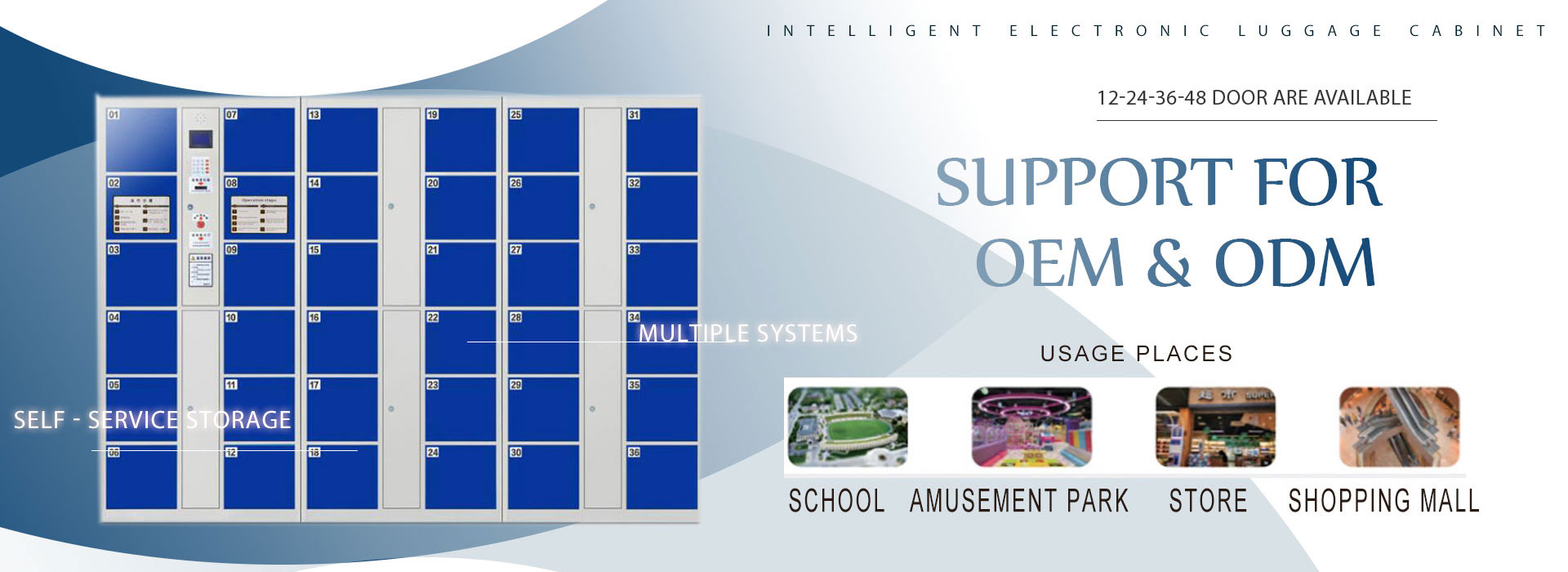
- 300 mm of depth — a 30-door unit stands 1125 × 900 × 300 mm against a wall: the footprint of a chest freezer, not a locker room.
Pick the socket before the door count
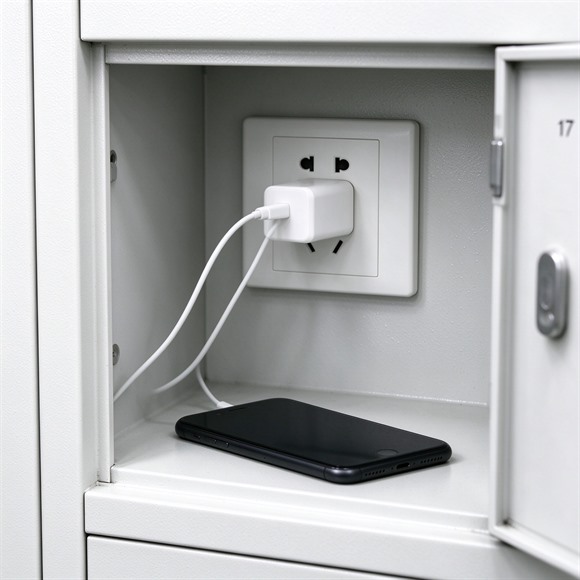
Door count is the easy decision. Socket type is the one people get wrong, and it decides whether staff bring a charger, whether cables disappear, and whether a tablet still fits.
| Socket in each compartment | Where it fits |
|---|---|
| Five-hole universal (two-pin plus three-pin) | The default. Staff bring their own charger, as most kitchens already expect. |
| Five-hole plus one USB-A | Mixed devices — a phone and the odd power bank. |
| Five-hole plus two USB-A | Where people forget chargers constantly. The cable stays in the compartment. |
| Two USB-A only | Cleanest look, phones only, no mains socket to misuse. |
| Four USB-A | Batch charging — phone banks, tablets, headsets. |
| Four-hole (two-pin plus three-pin) | Older buildings still wired with two-pin outlets. |
Then door count, which follows the rota rather than the payroll. Forty employees on two shifts need room for the larger shift plus whoever is late off, not for all forty at once.
| Doors | Size H × W × D (mm) | Rota it suits |
|---|---|---|
| 12 | 600 × 725 × 300 | Small café, one shift plus part-timers |
| 20 | 775 × 900 × 300 | Neighbourhood restaurant, 15–20 on the rota |
| 30 | 1125 × 900 × 300 | Mid-size site, 25–30 across two shifts |
| 40 | 1475 × 900 × 300 | High turnover — students who leave each term |
| 50 | 1825 × 900 × 300 | Large operation with events on top of service |
| 60 | 1825 × 1075 × 300 | Hotel kitchens, or one bank across outlets |
One thing that catches people out: these ship assembled, not flat-packed. Measure the door it comes through and the turn at the bottom of the service stairs — a 60-door unit is 1075 mm wide at the base.
Door count follows the rota rather than the payroll, and the formula is worth running before the socket table gets signed off.
Where it goes in a restaurant
| Back door / staff entrance | The one that works. Everybody passes it coming in and there is only one route, so nobody can plausibly forget. |
| Changing area | Good if staff already change on site. Watch the 6pm bottleneck: if it doubles as the break room, the queue becomes the reason people stop using it. |
| Kitchen corridor | The one to avoid. Grease film on a keypad and wet hands on a reader is weekly maintenance. |
| Behind the bar | No. Guest sightline, staff workspace, and usually an escape route. |
Wherever it lands it wants 300 mm of depth, a level floor and an earthed socket within reach. Not an extension lead, and not a socket that also feeds the ice machine.
The electrical side is the part that goes wrong
Thirty phones on one cabinet in a wet environment is a real load. The build runs a residual current device that trips at 30 mA or less, an air switch for voltage faults and a breaker for overload, wired in 2.0 mm copper rather than aluminium, conductors colour-coded and clipped to the back panel so nothing swings loose in transit.
Two things sit outside the cabinet. The socket should be earthed and ideally on its own circuit — ask the landlord before anyone drills. And keep it off trailing leads; a splitter tucked behind a chest freezer is how these fail an inspection.
For the record, none of this needs a new circuit or a network point — what the cabinet does require is set out in four lines.
Two weeks is enough to know whether it works
Do not judge it on day one. Judge it on day fourteen, with three numbers:
- Share of the shift using it on day twelve. Above 80 per cent means position and rule are right. Below half means the cabinet is on the wrong wall.
- Calls to the manager in week two. “I forgot my code” should be near zero. If not, the onboarding needs work, not the lock.
- Phones found outside the cabinet. Zero. One is a person; a steady trickle means the rule has an exception nobody closed.
If the first number is low and the other two are fine, move the unit four metres to the door staff actually use before you blame the product. That change fixes most of these installations.
If the team is hotel housekeeping rather than a restaurant crew, the same argument for code lockers is worked through here, including why a folded uniform fits a 270 by 300 mm compartment.
Questions restaurant owners ask
Can it charge overnight?
It can, and with the timer option it will not — power drops outside the window you set. Most kitchens set it for the prep hour.
One key per person, or one for the bank?
One lock per door. Spares stay in the office sorted by number, and a cylinder swaps over when someone leaves with a key.
Does it need wifi or an app?
No. It runs standalone — nothing to subscribe to, and nothing that stops when the router does.
What if a phone is left inside?
The manager holds an override key or admin code, the compartment opens, the phone goes back. Same routine as any staff locker.
What to send us
- How many staff are on shift at once, and roughly how many pass through the rota in a year — the second number usually decides door count.
- Whether staff bring their own chargers, or the cable should stay in the compartment.
- A photo of the wall you have in mind, plus the width of the door the unit has to come through.
Send those three and we reply with a configuration and a quote within 24 hours. If a smaller cabinet or a different product suits your building better, that is what the reply will say — we would rather lose the order than ship a bank that becomes a shelf. Where staff also need somewhere for jackets and bags, the mechanical key lockers cover the changing room, and the self-set code cabinets suit mixed shifts where nobody wants to hand out keys.