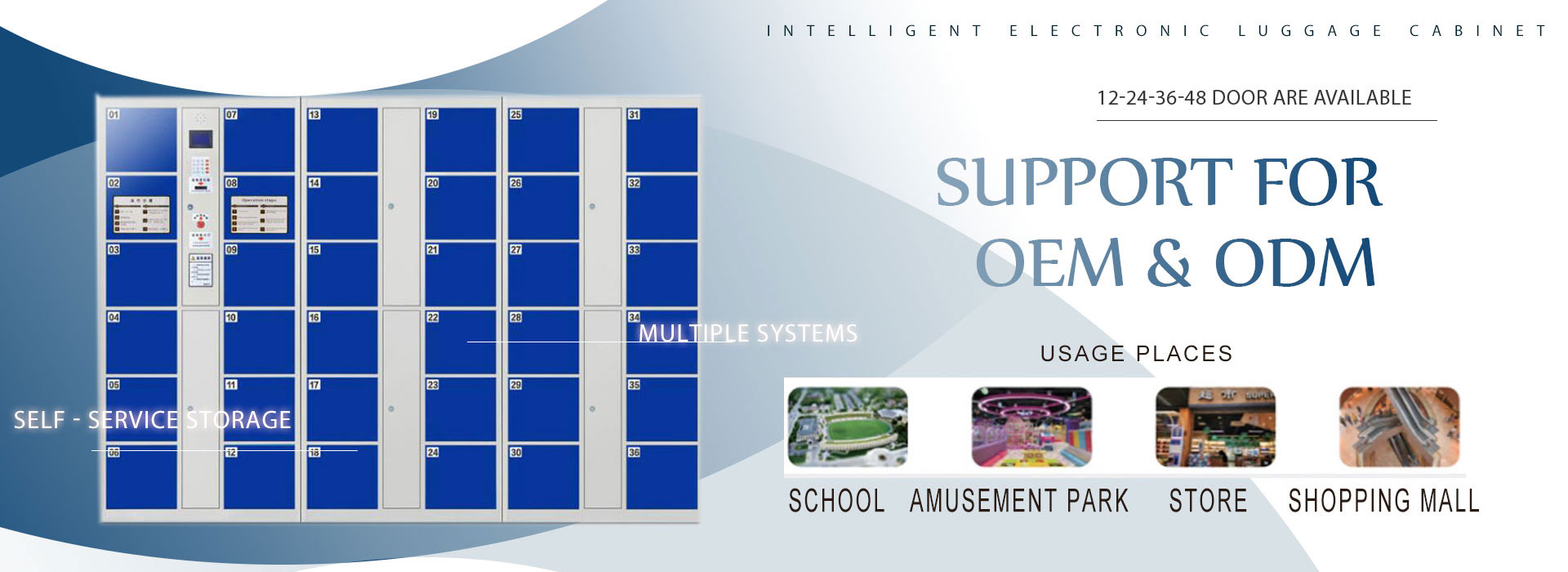
A mall operations meeting usually goes the same way. Someone proposes card lockers for the corridor by the car park lift. Five people speak, and each one has a reason it will not work.
Most of those reasons deserve an answer. One of them is a fact about the building that no amount of planning will change, and the other four are arithmetic. Here they are in the order they usually come up.
1. “It costs more than a key locker — why would we pay that?”
The steel is not what you are paying for. A key locker and a card locker start from the same cold rolled body and the same powder coat. The difference is a reader, a controller and an electronic lock on every door.
What that buys is the end of key handling, and key handling has a cost that never appears on a purchase order. A 900-member gym where 15% of visits involve a locker sees 135 locker uses a day. At forty seconds of staff time each — finding the key, checking the member, writing it down, taking it back — that is ninety minutes a day, or roughly 550 hours a year.
550 hours is the number to argue about, not the unit price. Whether it is worth the difference depends on what an hour of your front desk costs. We are not going to pretend it always is.
2. “We have a front desk. They hold bags.”
A front desk is good at answering questions. Storage is a different job, and three things go wrong when the two are combined.
- Timing. The desk is staffed when the venue is staffed, and the queue arrives when the venue is busy. Those are the same hour.
- Record. A bag behind a counter has no log of who left it or when it left. When something goes missing, the conversation is two people and a memory.
- Capacity. A desk can hold twenty bags. Twenty-four doors hold twenty-four, and they are still holding them at nine in the evening when the desk has gone home.
3. “Our peak will swamp it.”
The number that matters is not daily visitors. It is how many people are inside a locker at the same moment.
Daily entries × share using a locker × minutes inside ÷ opening hours.
A 600-member gym, 300 entries a day, 15% using a locker, 90 minutes average, 16 hours open: 300 × 0.15 = 45 uses a day; 45 × 1.5 hours = 67.5 locker-hours; divided by 16 = 4.2 people inside at any one moment.
Four doors cover the average. Twelve cover the average and a Saturday morning.
This is where most gym projects over-order. Twenty-four doors is not wrong; it is four times the arithmetic, and it takes wall space in the room where people are trying to change. Mall projects run the same sum on shorter stays and larger counts, and usually land on a bank near the washrooms or the lift lobby rather than the main entrance — because that is the point where people decide they do not want to carry a bag any further.
4. “We already have a membership card system.”
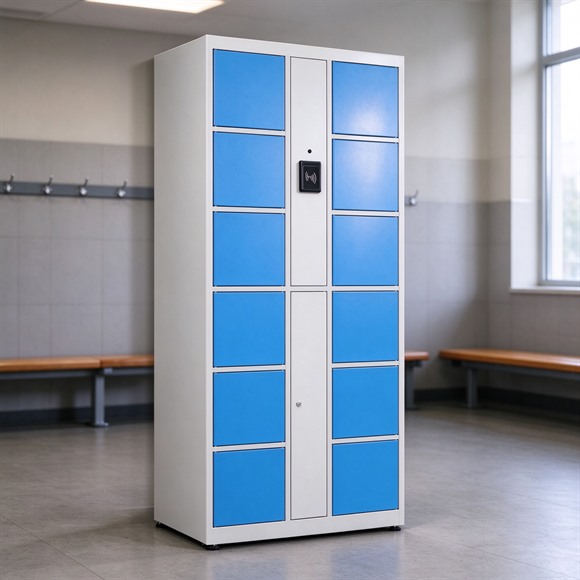
Then you are most of the way there, provided the card is contactless IC. The reader sits on the control column and reads the credential you already issue. No second account, no app, no re-registration queue on the first Monday.
Two card types cause trouble. Magnetic stripe cards, which are being retired in most markets, and phone-only access, which needs a different reader entirely. If your cards are contactless, send one physically before the order rather than describing it in an email — a reader that rejects the cards you already issue is an expensive discovery.
5. “And when it breaks?”
Four answers, in the order they matter.
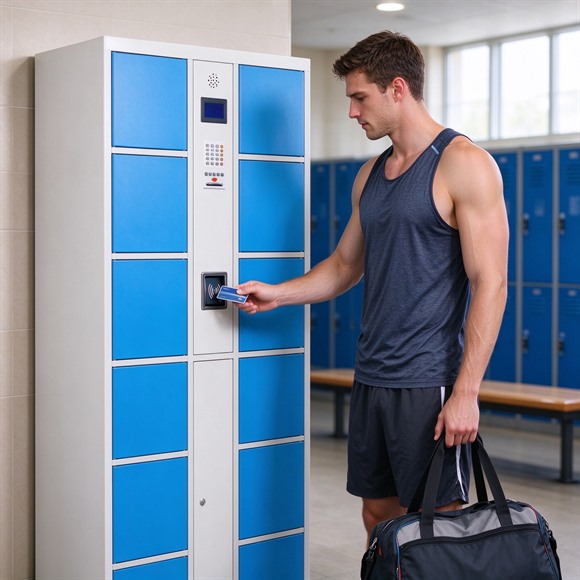
- Every door has a mechanical key path. If a reader dies, the duty manager opens the compartment with a key and the member gets their bag. The cabinet does not turn into a wall.
- One failed door does not take the bank down. The controller addresses each lock separately and the rest keep working.
- A lost card is administration, not a locksmith. Remove it from the member record, issue a replacement, done. A lost key means a new cylinder, a new key, and a door out of service until somebody gets round to it.
- Power. The cabinet runs from one earthed socket and needs no network connection. On a cut it stops accepting new use; when power returns it comes back. Ask whether the model keeps its compartment memory through the cut — some do, some release, and it changes what your staff walk into at 6am.
What a 24-Door Bank Needs on a Club Floor
A 24-door unit against a wall takes about two metres of run and 1.2 metres of depth, and it needs 1.5 metres in front of it so members can stand at a door without blocking the walkway. That footprint is the number to measure first — clubs that skip it end up with a bank that blocks the changing-room door.
Peak Hour, Not Membership Count
For a club with 200 to 300 members, 24 compartments usually carry a normal evening. Above 400 members, or where the club runs 24/7 access, two units side by side give 48 doors and remove the question. Peak hour is what decides it: count the members who train between 6 and 8 p.m., not the membership list. Maintenance on a gym bank is mostly about hinges. Doors get opened and slammed 10 to 15 times a day on a busy floor, and cheap hinges start squeaking within six months. A heavier hinge and a door that closes on its own is the difference between a unit that still feels new in year two and one that members complain about.
What it will not do
Three limits worth knowing before anyone signs.
- It will not tell you who is inside a compartment, only which card opened it. If you need occupancy, that is a different sensor.
- It will not replace a membership system. It reads your card; it does not renew it, bill it or talk to your CRM.
- It will not fix a queue caused by one slow door. If a member stands at the cabinet for two minutes reading the instructions, that is a signage problem, and a printed card taped beside the control column does more than a firmware update.
The only objection that is a fact, not arithmetic
Four of the five scale with arithmetic. The fifth is a property of your building: the card either works with the reader or it does not.
Which is why the useful question at the end of that meeting is not whether to buy card lockers. It is which card members actually carry, and whether one can be posted to the supplier before anyone signs. The key-operated side of the same decision is covered under mechanical key lockers, and the card and barcode ranges sit together under electronic locker systems.
Who pays is usually not who benefits
In a mall this is the objection nobody says out loud. The operator pays for the bank and the fit-out; the benefit lands on tenants, whose customers stay longer, and on visitors, who stop carrying coats around. In a gym the same split exists between the club and the member.
It changes the business case, not the arithmetic. If the operator is funding it, the argument that works is footfall and dwell time, not staff savings — because the staff being saved usually belong to somebody else. If a single tenant is funding it, the argument is their own queue.
Worth deciding which of those two you are before the second meeting. Projects that fail in committee almost always fail here: everyone agrees the lockers are useful and nobody agrees whose budget line they come from.
Three things to settle before the order
- The card, as an object. Post one. Contactless IC works; magnetic stripe and phone-only do not, and you want to know that before the order, not after.
- The peak, not the headcount. Count the busiest two hours on a Saturday, not the daily total. The sum above only needs one honest number, and it is rarely the one in the annual report.
- The position. Changing room door, not reception. A bank in the wrong place runs at a third of the rate and nobody can explain why.
Settle those three and the rest is a door count, a delivery and a socket. Leave them open and the same meeting happens next quarter with the same five objections.
The peak-hour sum behind a club floor is worked through in card-operated lockers for health clubs, and the ventilation question in ventilated lockers for gyms.