A requisition form crosses a desk with one line on it: staff lockers, 60 units, card access. Somebody signs it. Eighteen months later the same form comes back with a note clipped to it — forty-two cards replaced this year, in a building of three floors and four departments that reorganise every time a director changes.
The card was never the problem. The reissue was.
Municipal buildings are unusually bad at cards because they move people constantly: secondments, restructures, job shares, staff who transfer floors without changing buildings. Every one of those moves is a card to collect, a card to print, and somebody in facilities remembering to do it.
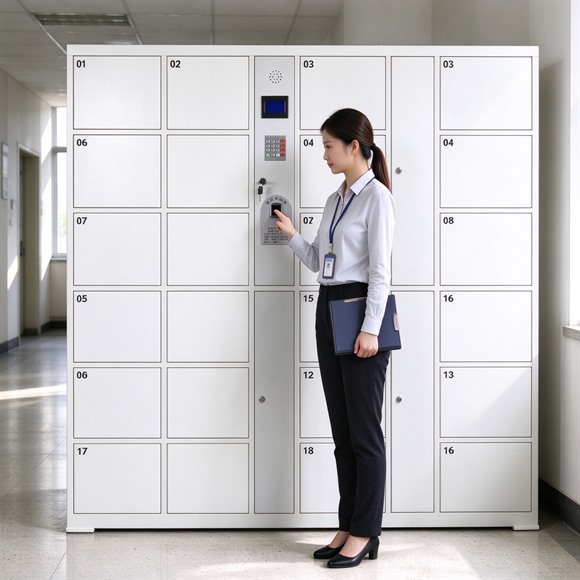
Three numbers that decide whether you need cards at all
Before the specification is written, three figures answer most of the question. They are usually already in the building, which is the annoying part.
- Peak staff on one floor, not total headcount. A 200-person building where nobody has more than 60 people on a floor needs 60 compartments on that floor, not 200.
- Moves per year, as a percentage. If more than one in ten staff changes floor, department or job in a year, card administration stops being a task and becomes a role.
- How many entrances the locker room serves. One entrance means one bank. Four entrances means four small banks, and four times the enrolment admin.
Run those three and the answer is often uncomfortable: the card system is being maintained for a churn rate it was never designed around.
Those three figures turn into a door count with one formula; the worked version uses a plant, a supermarket and a hospital.
A specification you can copy onto the requisition
Most municipal tenders for staff lockers fail on wording, not on budget. The form asks for “lockers with secure access” and every supplier answers a different question. These are the lines worth putting in writing.
| Line on the form | What to specify | Why it decides the outcome |
|---|---|---|
| Door count | 24 or 36 doors per floor bank | Sized on the peak on that floor, not the payroll |
| Compartment size | Roughly 270 mm high | Takes a handbag, a folded jacket and a phone — the kit staff actually carry |
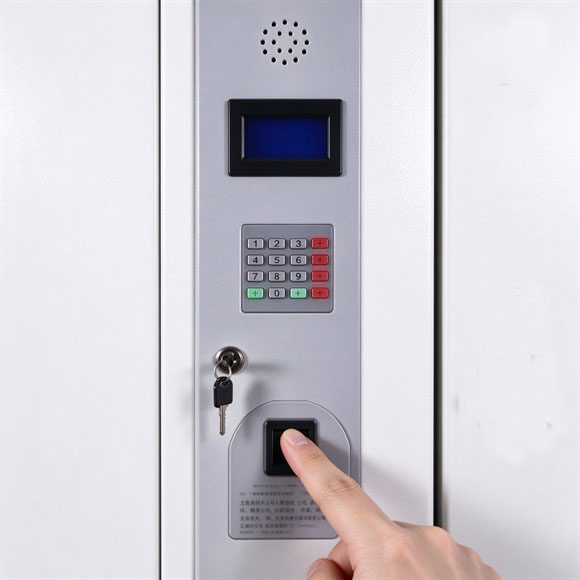
| Access method | Fingerprint, one-to-one enrolment | No card to issue, no code to reset when someone forgets |
| Enrolment | Who enrols, where, and how long per person | A two-minute enrolment at the bank beats a card print queue across a city |
| Power | One socket at the bank | The cabinet is self-contained; nothing else is needed to open a door |
| Network | Only if usage reports are required | Access works without it; reports do not |
| Spare capacity | 15% more doors than the peak | Restructures happen; empty doors are cheaper than a second order |
| Floor condition | Level and dry, with a plinth if it falls away | Doors on an out-of-square frame jam within a month |
Fingerprint, card, code or key — where each one belongs
No single method suits a whole building. The useful question is which method suits which room.
| Method | Where it fits | Watch out for |
|---|---|---|
| Fingerprint | Staff churn is high and the building already has no unified card | Cold or damp hands read slowly in winter; gloves mean using the mechanical key |
| Card | The building already issues access cards to every employee | Reissue admin every time someone changes floor |
| PIN code | Visitors, agency staff, short-term cover | Shared codes undermine the audit trail |
| Mechanical key | Plant rooms, stores, anywhere without reliable power | Lost keys, no record of who opened what |
Where gloves stay on all shift and a mask comes off only at break, face recognition on a production floor takes the same decision from the other end.
The building will push back
Municipal buildings are old more often than they are new, and the installation problems are predictable.
- Stone or brick walls. Routing cable to a corridor bank usually means surface trunking, which needs agreeing with whoever owns the interior.
- No data point in the basement. Not a blocker: the bank opens doors without a network connection, and only reporting needs one.
- Floors that fall away towards old doors. A bank standing on a slope racks its frame, and a racked frame jams. Sort the plinth before the delivery date, not after.
- Cleaning and security staff need in. Enrol a named supervisor as the administrator during commissioning, and write the handover into the cleaning contract.
- Public-facing hours. Position the bank so staff reach it without walking through a public counter area in a wet coat.
Old buildings cause most of the delay, and almost none of it is electrical — the requirements are four, listed here.
Five mistakes that show up in municipal tenders
- Sizing on headcount. It produces a bank three times the size of the real peak, and an empty half that nobody maintains.
- Specifying cards by default. Usually because a card system already exists in the building — even when the card is the thing causing the work.
- Forgetting enrolment. Nobody writes “who enrols 200 fingerprints” into the contract, so it lands on the supplier’s installer and takes a week.
- No spare doors. The first restructure eats the spare capacity, and the second one needs a new order.
- Siting the bank where nobody walks. A locker room in a dead corridor becomes a storage cupboard within six months.
The first week decides whether it gets used
A bank that goes live on a Friday and gets explained on a Monday will be half-used by the end of the month — not because it failed, but because people walked past it twice without knowing what it was for. The buildings where this works do three things in week one: enrol everybody in person, keep a named administrator at the cabinet for the first three mornings, and post a one-page guide next to it in the language the cleaning and security teams actually read.
Questions procurement teams ask
How long does it take to enrol a member of staff?
Minutes, not hours, and it happens at the cabinet rather than at a badging office. The practical constraint is having someone available on the first day to do it for a queue of people.
What happens if a fingerprint will not read?
The supervisor opens the compartment with the mechanical emergency key. That is why the administrator has to be named on day one, not discovered on the day it happens.
Do we need to connect it to the council network?
No. Access works offline; a network connection is only needed if you want usage reporting, and that decision can be made later without changing the cabinet.
Can one floor have fingerprint and another have cards?
Yes — methods can be mixed across a main cabinet and its extensions. The control system is shared, so both appear as one bank to whoever manages it.
What to send us
Send the peak headcount per floor, the number of floors, and the annual staff move rate if you have it. With those three figures we come back with a door count per floor, a proposed split of banks and a quote within 24 hours. MOQ and lead time are confirmed with the quotation, because colour and interface language change both. CE certification is available, and OEM and ODM work covers logo, screen language and the manual.
Building a specification across several rooms? The electronic locker range covers card, barcode and face recognition entry, and the mechanical key lockers suit plant rooms and stores where power is not reliable.