A barcode storage cabinet is not a locker with a printer bolted to the side. The slip is what makes the whole thing work: it is the only object that travels with the user, and the only proof of which compartment holds their bag when the screen has already forgotten them.
What follows is the cycle as it actually runs in service, the door counts that exist, and the four failures that staff end up handling. It is written for the person who has to specify the cabinet and then live with it.
One deposit, from button to closed door
Six steps. Only two of them involve the person touching anything electronic.
- The user presses Deposit. The controller assigns a free compartment and that door springs open on its own.
- They put the bag in and close the door. The compartment is now marked occupied.
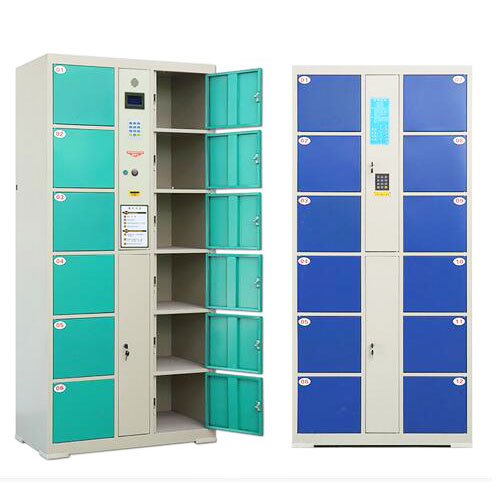
- The printer issues the slip: a barcode, a numeric code, and the compartment number in large type.
- On collection they hold the slip to the reader. If the barcode reads, the door opens in about a second.
- If it does not read, they type the numeric code on the keypad. Same result, eight more seconds.
- The door opens, the compartment clears, and the record closes. A door left hanging open stays marked in use until a member of staff clears it.
No account, no app, no registration queue. That is the reason this lock type survives in stations, hospital lobbies and mall corridors, where most users will never come back a second time.
Why the slip carries three things instead of one
A barcode by itself fails the moment the paper is folded into a pocket. A numeric code by itself means typing while a queue builds behind you. Both, plus the compartment number printed large, gives three different people a way in:
- The user scans, and it takes a second.
- The user whose slip is creased types the code instead.
- Staff read the compartment number off the slip and open that door with the management code on the control column, without needing the user’s code at all.
Two practical notes that only show up after installation. The slip is thermal paper, so it fades in a hot car and goes blank after a week on a dashboard — a line on the instruction card telling people to photograph the slip costs nothing and removes most forgotten-code visits. And the paper roll runs out at the worst possible hour, which is why the spare rolls belong at the front desk, not in a cupboard on another floor.
Door counts: 12, 24, 36, 48
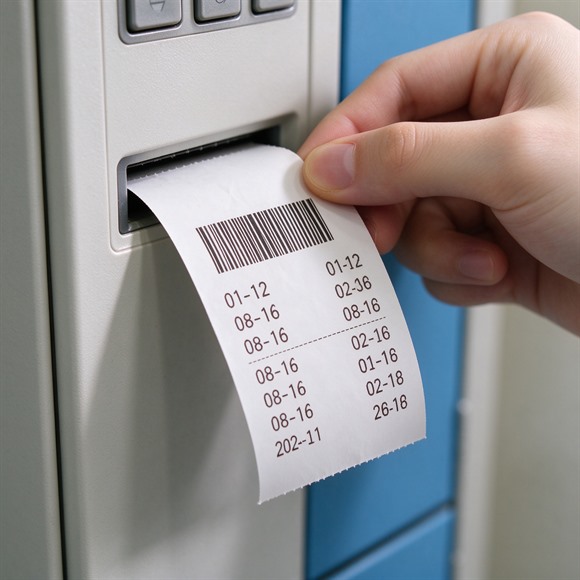
The cabinet is not one welded block. Twelve doors make one body: 850 mm wide, 1800 mm high, 460 mm deep. A bank is two, three or four of those bodies bolted together, up to 3400 mm overall. Each door is 270 mm wide and 300 mm high, which is a laptop bag, a helmet and a coat, or two shopping bags.
| Doors | Bodies | Overall width | Where it usually lands |
|---|---|---|---|
| 12 | 1 | 850 mm | Clinic reception, small gym, single entrance |
| 24 | 2 | 1700 mm | One floor of a mall, school main building |
| 36 | 3 | 2550 mm | Station concourse, hospital outpatient hall |
| 48 | 4 | 3400 mm | Stadium, exhibition hall, logistics front desk |
The number is arithmetic rather than instinct. Daily deposits, times the share of people who need storage, times the hours a bag sits inside, divided by the hours the venue is open, gives the compartments in use at the peak.
A clinic taking 400 deposits a day, where 30% of visitors want a locker and the average stay is three hours, across a ten-hour day: 400 × 0.3 = 120 deposits, 120 × 3 = 360 locker-hours, 360 ÷ 10 = 36 compartments busy at once. At that point a 36-door bank is exactly enough and a 24-door bank is a queue by ten in the morning.
Eighteen doors also exist, as a made-to-order size for rooms that cannot take a 24-door run. The width is confirmed with the drawing rather than assumed from a table.
What the room has to provide
One earthed socket on the wall behind the cabinet. That is the entire list.
- A flat floor and a wall to stand against. No plinth, no fixing bolts.
- No network connection. The controller runs standalone and keeps its own record of which compartment is occupied.
- No dedicated circuit and no rewiring of the distribution board.
- Delivery, not installation: the bodies arrive as separate units, get bolted to each other, plugged in, and switched on.
If you later want the deposit log on an office screen, that is a different controller and a different conversation. It is not something the cabinet needs in order to open a door.
Where in the building it belongs
The same cabinet in two positions in the same building will run at two different rates, and the difference is not promotional.
Put it where people have already decided they are not carrying the bag any further. In a mall that is the corridor by the car park lift or the washrooms, not the front entrance, because at the entrance people are still optimistic. In a hospital it is the outpatient hall rather than the ward floor, because that is where the visitor with a suitcase first looks around.
Two conditions on top of that. The cabinet wants a sightline from something staffed, so a problem gets noticed in minutes rather than at closing time. And it wants a metre of clear floor in front of it, because an open door plus a person reading a slip is the space you actually need, not the 460 mm of cabinet depth.
Barcode, card or fingerprint — where the line sits
All three open a door. They differ in who can use them without being enrolled first.
A barcode works for someone who holds nothing with you: the hospital visitor, the passenger with two hours to kill, the shopper who came in for one thing. That is the case this cabinet is built for, and it is the reason the paper slip exists at all.
A card works when the same people come back daily and already carry a staff badge or a membership card. The reader sits on the same control column and reads the credential you already issue — the mechanics are covered under electronic locker systems, and the card-versus-key argument is set out in card lockers for malls and gyms.
A fingerprint removes the lost-slip problem but adds an enrolment step for every first-time user, which is precisely the person a public venue cannot ask to queue twice.
And below all of them sits the mechanical locker: one door, one key, no power. Where staff turnover is low and the room is a changing room, key lockers still cost less to own for the same amount of storage.
The four things that go wrong in service
- The printer jams or runs dry. The cabinet still opens doors; it just cannot issue a slip. Staff hand-write the compartment number, and the roll gets changed. Thirty seconds, if the spares are at the desk.
- The slip is lost. The compartment number is the fallback. Staff open that door with the management code, check the contents against the description, and log it. A lost slip is administration, not a locksmith.
- One door will not latch. The controller addresses each lock separately, so one failed door is one compartment out of service and the rest keep working.
- The power goes. The cabinet stops accepting deposits until it comes back. Whether it keeps its compartment memory through the cut depends on the model — ask that question specifically, because it decides what your staff walk into at six in the morning.
Notice what is not on that list: nothing here needs a technician on site. Which is the point of the printed number and the management code.
Specifications
| Item | Range |
|---|---|
| Doors | 12 / 18 / 24 / 36 / 48 |
| Bodies | 1 to 4 bodies, 12 doors each |
| Overall size | H1800 × D460 mm; width 850 to 3400 mm by body count |
| Single door | W270 × H300 × D460 mm |
| Colour | White body with sky blue, police blue, orange-red or fruit green doors |
| Access | Printed barcode slip with numeric code, issued at deposit |
| Slip contents | Barcode, numeric code, compartment number |
| Power | One earthed socket on the wall behind the cabinet |
| Network | Not required |
| Structure | Bodies bolted side by side, delivered assembled |
What to send with an enquiry
Four answers make the difference between a quotation and a conversation:
- Door count, or the daily deposit figure and the average stay if you would rather we work it out.
- Where it stands: indoors, under a canopy, or against an outside wall.
- Which credential: paper slip only, an existing card, or a mix of both.
- Whether the site needs a bilingual instruction card and a spare roll pack in the first shipment.
The loading plan, the finish and the delivery schedule come back with the quotation.
Where each parcel needs its own receipt, the ticket flow is set out in mall electronic storage lockers, with the door count from twelve to forty-eight in 12-door barcode cabinets for facility managers.