Two o’clock at the gate of a site running three shifts. The outgoing crew is queuing to get their kit, the incoming crew is queuing to hand theirs back, and somewhere between the two queues is a supervisor with a key board and a clipboard.
Two hundred people work here. Nobody has time to hand out two hundred keys, twice a day, and nobody does — which is why half the lockers in the welfare cabin are either permanently “taken” by someone who left last year, or standing empty because the key is missing.
Above roughly a hundred staff, key-based storage stops being administration and becomes a bottleneck at exactly the moment you cannot afford one.
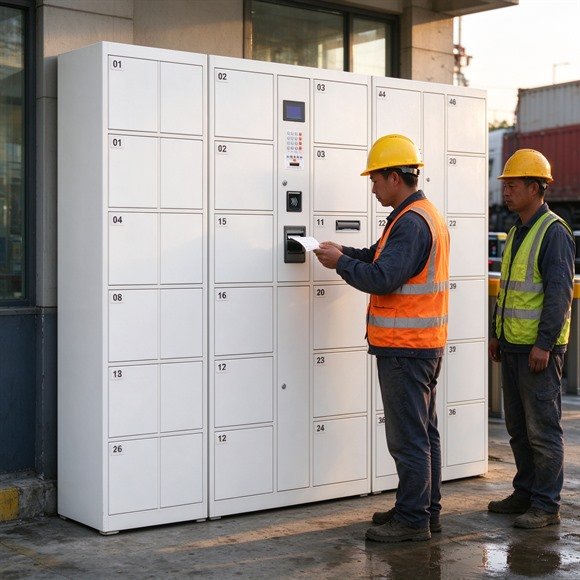
What breaks first on a site this size
- Assignments outlive the people. A locker stays “assigned” for a year after the person left, because nobody wants to cut a padlock off.
- Shifts collide. Morning and afternoon crews overlap by thirty minutes, which is exactly when two people need the same locker.
- One lost key becomes a work order. At two hundred staff, key loss is not an event, it is a monthly figure.
- The supervisor becomes the lock. Everything routes through one person, and the site stops when that person is on leave.
One scan in, one scan out
A barcode bank removes the person from the transaction. The worker walks up, presses one button, and the printer issues a slip with a barcode, a short numeric code and the cabinet number. The door opens, the bag goes in, the door closes. At the end of the shift the barcode is scanned at the reader and the same door opens.
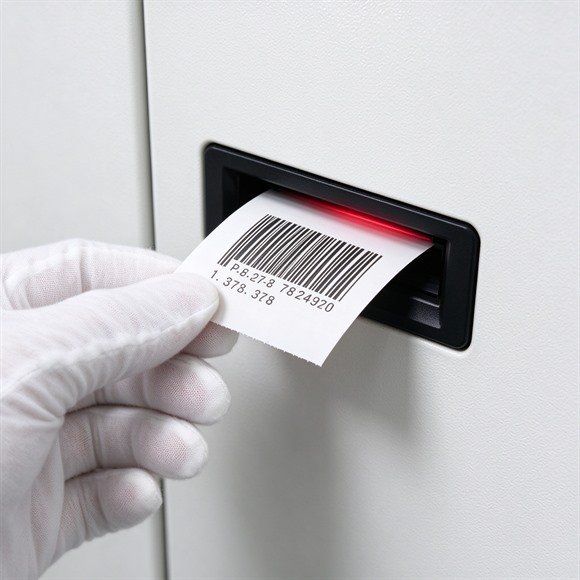
Nothing is issued to a named person. Nothing is assigned for a year. A crew that turns over every quarter needs no administration at all — the slip goes in a pocket, and the compartment is free again the moment it is emptied.
Whether that scan should be a printed slip or a card at all is a separate decision, and the two failure modes are compared side by side here.
How 48 doors covers 200 staff
The arithmetic is about shifts, not headcount. If a site runs three shifts, the peak on site at any one time is roughly a third of the payroll — and a 48-door bank serves a 48-person peak comfortably, with the rest of the day turning over.
| Bank configuration | Doors | Handles a peak shift of | Typical site |
|---|---|---|---|
| Main cabinet + one extension | 48 | About 45–50 on site at once | 200–250 staff on three shifts |
| Main cabinet + two extensions | 72 | About 70 on site at once | 300–350 staff, two-shift overlap |
| Main cabinet + three extensions | 96 | About 90 on site at once | 400+ staff, or a site where the whole crew starts together |
That is why the 48-door size is really a starting point rather than a limit: the main cabinet carries the controller and printer, and the extensions add doors without adding a second system or a second queue.
Throughput at the gate
The number that decides whether a bank feels fast or slow is not doors, it is seconds per person at the machine. A worker who already knows the routine takes well under a minute: press, take the slip, open the door, load, close. First-timers take two to three minutes, which is why the first week matters more than any specification.
- Put the bank where the crew already walks — beside the time clock or the gate turnstile, not in a separate room.
- Brief the slip system once, on day one, in the language the majority of the crew reads.
- Keep one person on the gate for the first three shift changes, then step back.
- Post the lost-slip rule next to the machine: type the numeric code, or see the supervisor.
The thirty-minute overlap is the real peak
On paper, a three-shift site has a steady third of its staff on site. In practice the outgoing and incoming crews overlap for twenty to thirty minutes at handover, and that window — not the shift itself — is what the bank has to absorb.
Two ways to handle it: size the bank for one and a half times the shift, or stagger the gate by trade so half the incoming crew arrives fifteen minutes later. Most sites do a bit of both, and the sites that skip this step are the ones where the queue looks like a failure on day one.
What the bank is built from
- Cold rolled steel with phosphate pre-treatment and powder coating, in a colour scheme that survives a welfare cabin rather than a showroom.
- Doors numbered from 01 upward, so the number on the slip matches the door without a second look.
- Thermal printer issuing barcode, numeric code and cabinet number on one slip.
- LCD screen, acrylic keypad and voice prompts — the voice matters more than people expect on a site where a share of the crew reads slowly.
- Mechanical emergency key for the supervisor, and power-loss memory on models that carry it, so a brief outage does not release every door.
- Plug and play. Assembled and tested before it ships; on site it is positioning, levelling and power.
Where the site is still arguing about door count, this is the arithmetic to settle it with — forty-eight doors is a starting point, not an answer.
Five checks before you order
- Peak shift, not payroll. Three shifts of 200 is a 70-person peak, not 200.
- Where the extension stops. Decide the final door count now; adding a cabinet later is easier when the controller was sized for it.
- Power and network at the gate. A socket is mandatory, a data point only if you want usage reports.
- Slipperiness of the floor. Wet boots at a site gate plus a smooth floor means the bank needs a mat and a level base.
- Who clears the bank at shift end. One rule, written down, or the cabinets fill with abandoned bags by week three.
Questions from site managers
Does every worker need a card or an app?
No. The bank prints a paper slip. Nothing to register, nothing to lose except the slip itself.
What happens when a worker loses the slip?
They type the numeric code printed on it. If that is gone too, the supervisor opens the door with the emergency key and checks the shift list before releasing the contents.
Can one bank serve two gates?
It can serve a gate area, but not two distant gates — the queue is the point. Two gates means two banks, or one bank plus a smaller satellite cabinet.
What if the power goes off mid-shift?
Doors stay shut, the emergency key still works, and on models with power-loss memory the assignments survive. A backup power connection is available as an option.
Can the interface be in our language?
Yes. Screen text, voice prompts and the manual can all be produced in the language your crew reads, and the door colours can match the site signage.
What to send us
Three numbers get you a real answer: staff on the biggest shift, how many shifts a day, and whether those shifts overlap. Add a photo of the wall by the gate and we come back with a door count, an extension plan and a quote within 24 hours. MOQ and lead time are confirmed with the quotation, because colour and language customisation change both. CE certification is available, and OEM and ODM work covers logo, screen language and the manual.
Smaller crew or a single gate? The barcode storage cabinet range starts at 12 doors, and the mechanical key lockers suit compounds where power is not reliable.