A bus station and a ferry terminal both need somewhere to leave a bag between arriving and leaving. They are also two completely different customers for the same cabinet, and the difference shows up in the queue at 7am rather than in any brochure.
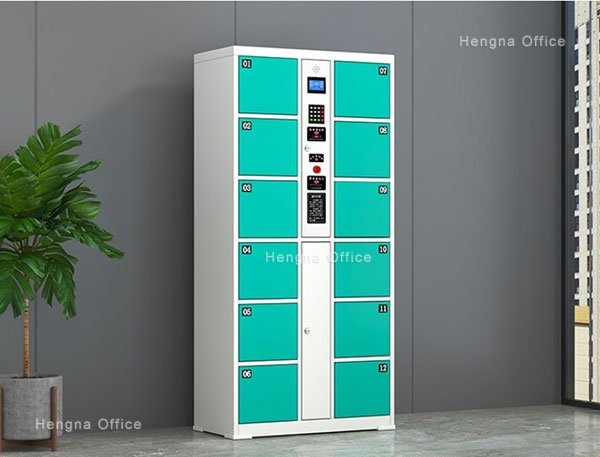
The unit on this page is a twelve-door barcode cabinet: 1800 × 850 × 460 mm, infrared scanner, thermal printer, one ticket per use. It is the same hardware in both venues. What changes is how long the bag stays, how big it is, and what happens when the ticket does not work.
The same cabinet, two different queues
| Bus station | Ferry terminal | |
| Typical stay | 20 to 60 minutes | 2 to 6 hours |
| Bag size | Backpack, shopping, small case | Suitcase, cooler box, family bags |
| Arrival shape | Sharp peak before each departure | Spread across sailings, swings with weather |
| Failure that hurts | A queue at the printer with a coach loading | A bag still inside after the last sailing |
| Doors needed | One unit usually covers it | Often two or three bodies |
Read the last row as the practical consequence. A bus station turns over quickly, so the same twelve doors serve far more people per day. A ferry terminal holds bags for hours, so the doors are occupied for most of the day and the count climbs even when footfall does not.
Where the two venues agree
Four requirements are identical, and they are the four that decide whether the unit gets used.
- The ticket has to come out in one motion. One button, one slip, out of the way. Any menu between the traveller and the door becomes a staff-assisted transaction.
- The ticket has to be replaceable. Somebody will lose it, wash it, or leave it in the hotel. There has to be a path that does not involve breaking a lock.
- Staff have to be able to open a door on their own authority. A mechanical key path on every door, not a service call.
- Power loss must not lose the contents. Ask specifically whether the model keeps its compartment memory through a cut. Some do; some come back with doors released. For a ferry terminal with bags inside overnight, that difference matters a great deal.
The venue decides the door count, not the footfall
Count how many bags are inside at the same moment, not how many people walk past.
Bags inside ≈ bags stored per hour × hours a bag stays.
Bus station, morning peak. 200 people an hour through the concourse, 8% storing a bag, average stay 40 minutes: 200 × 0.08 = 16 bags an hour; 16 × 0.67 = roughly 11 bags inside at any moment. Twelve doors is a comfortable fit with one spare.
Ferry terminal, one sailing. 150 passengers, 20% storing a bag for a four-hour crossing, sailings every two hours: 30 bags per sailing, each occupying a door for two sailing cycles, so about 60 doors are occupied in steady state. One twelve-door unit covers the shoulder season and nothing else. Fifty travellers with suitcases on a Friday will fill it before the second sailing.
This is the arithmetic most transit projects get wrong, and it is not a sales argument — one unit is genuinely enough for the first venue and genuinely short for the second. The good news is that the cabinet is built in twelve-door bodies: one body is 850 mm wide, and up to four bodies can be bolted into a single run of 48 doors, sharing one control column and one printer. A terminal that starts with twelve doors in June can add a body in September without replacing anything.
The ticket is the weakest part of the system
Thermal paper is a good medium for a receipt and a poor one for a credential that has to survive a bus journey. It goes grey in damp, fades in a hot car, and delaminates in a jeans pocket after a wash.
Two cheap habits remove most of the failure:
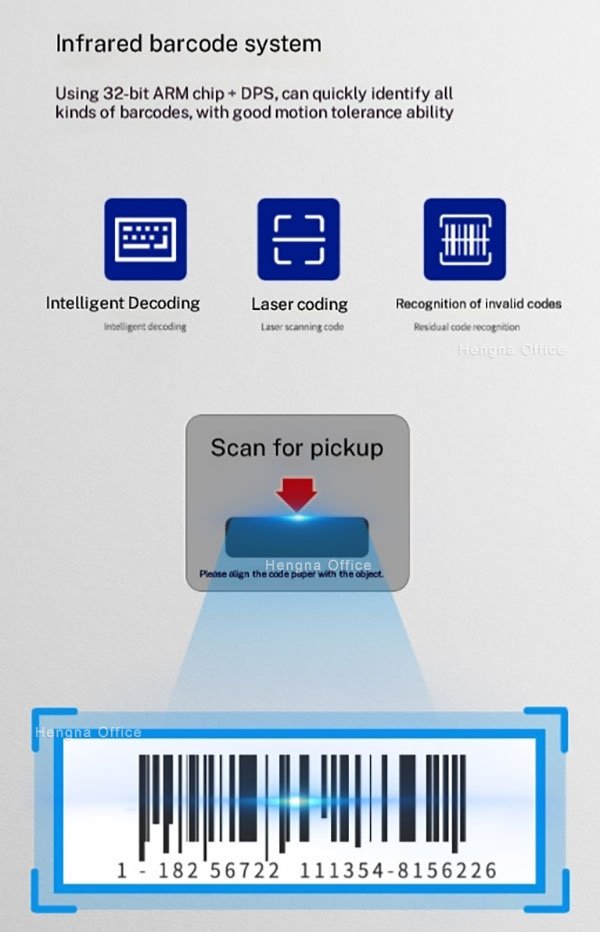
- Print the short code as well as the barcode. A number can be typed in when the barcode will not scan; a smudged barcode on its own cannot be rescued.
- Tell users to photograph the slip. One line on the control column does more than any amount of staff training, because the traveller already photographs everything.
Behind that, staff need a route that is not a drill. Verify identity, open the door from the management console, log it. If that process lives in one person’s head, it becomes a phone call at 11pm.
Specifications
| Item | Detail |
| Model | HN-12B-Barcode |
| Overall size | H1800 × W850 × D460 mm |
| Compartments | 12, sized for a backpack or a medium suitcase |
| Body | Cold rolled steel, anti-corrosion pre-treatment, electrostatic powder coat |
| Control | 32-bit ARM controller with DSP decoding |
| Reading | Infrared barcode scan, tolerant of a creased or partly obscured slip |
| Output | Thermal ticket carrying barcode, short code and door number |
| Emergency | Mechanical key path on every door |
| Extension | Up to four bodies per run, 48 doors, one controller |
| Colours | Standard range plus custom, logo printing available |
No single-door dimension is quoted here on purpose. The compartment geometry of a twelve-door body is fixed by the 1800 × 850 frame, and quoting a figure that does not reconcile with the frame is how specification sheets end up argued about on site. If you need the internal clear size for a specific suitcase, ask and we will measure the current production batch rather than quote from a table.
The two things that go wrong in month one
Neither is a hardware fault, and both are cheap to prevent.
The printer runs out of paper on the busiest morning of the week. Paper is the one consumable in the system and it always empties at the worst moment, because that is when it is being used. Two spare rolls on site and one person per shift who knows how to change them covers it. A terminal that has to wait for a delivery is a terminal with a handwritten queue beside it.
Somebody treats it as free left luggage. A bag goes in on Monday and is still there on Friday, occupying a door that paying travellers need. This is a policy question, not a technical one: decide the maximum stay before the unit goes live, put it on the control column in one line, and give staff a routine for emptying the bank at closing. Ferry terminals need this more than bus stations, because the stay is naturally longer and nobody notices a bag that is one day older than it should be.
Three things to settle before you specify one
- Where the bag is going, not where the people are. A bank by the departures board is used; the same bank fifty metres down a corridor is walked past. Position changes the door count more than the population does.
- How the ticket gets replaced. Write the override procedure before the unit arrives, and name two people who can do it, not one.
- Whether twelve doors is the first body or the only one. A bus station can start and finish with one. A ferry terminal should plan the footprint for three and install one, because the second and third body are bolted on later with no change to the control system.
The barcode storage cabinet range covers the same platform in other door counts, and if the venue issues cards rather than tickets, the card-operated lockers use an identical body with a different reader.