Half past eight in an outpatient hall. The queue starts at the registration desk and doubles back past the pharmacy. Between the chairs, under the chairs and along the wall, there are bags — school bags, shopping bags, a suitcase, one cardboard box with a blanket in it.
By ten, a security guard is walking the hall asking whose bag is whose. By eleven, someone is at the desk saying their bag was moved, or taken, or is simply not where they left it. None of that appears in the appointment system, and all of it lands on the people working the counter.
Bags on the floor are not a tidiness problem in a hospital. They are a queue problem, a complaint and a security question at the same time.

Why bags slow an outpatient counter down
- The patient will not leave the bag. Somebody sits down with a suitcase and keeps it between their feet, which takes two chairs and one queue position out of circulation.
- Staff become bag minders. Reception ends up watching other people’s property, and the moment there is a complaint, “we were watching it” is a difficult sentence to defend.
- Losing a bag costs more than the bag. A missing bag becomes a formal complaint, sometimes a police report, and always an hour of somebody’s shift.
- Nobody wants to be first. Once one bag sits on the floor, three more appear within the hour — and by afternoon the hall has become a cloakroom with no attendant.
What the counter actually needs
Not a staffed cloakroom. An outpatient counter cannot spare a person to hand out tickets and hang coats, and patients arrive outside any single shift.
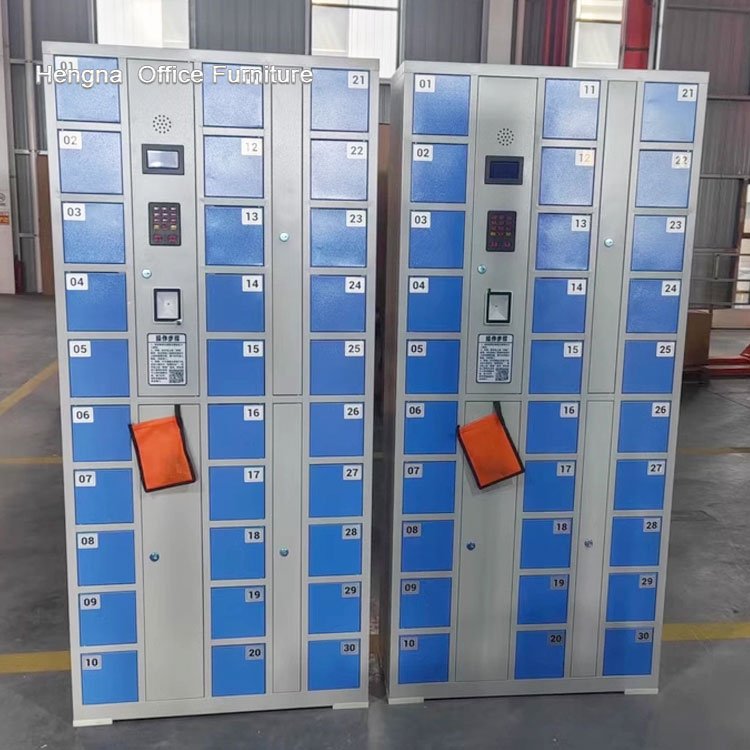
A ticket-printing barcode bank does the job with no attendant. The patient presses one button; the printer issues a slip carrying a barcode, a numeric code and the cabinet number. The door springs open, the bag goes in, the door closes. On the way out the barcode is scanned at the reader and the door opens again. If the slip is lost, a numeric code on the same slip still works — and if that is lost too, an administrator opens the compartment with a mechanical key.
| Doors | Overall size H×W×D (mm) | Where it fits |
|---|---|---|
| 12 | 1800 × 850 × 460 | Single counter, satellite clinic, imaging waiting area |
| 18 | Made to order | Between the 12 and 24-door banks, smaller halls |
| 24 | 1800 × 1700 × 460 | Main outpatient hall, registration plus pharmacy |
| 36 | 1800 × 2550 × 460 | Busy departments, two counters sharing one bank |
| 48 | Made to order, 460 deep as standard | Large hospitals, main entrance level |
How many compartments a counter actually needs
Count turns, not people. A bag that comes in at 8:30 usually leaves by 9:15, so one compartment can serve several patients in a morning. What matters is the worst fifteen minutes, not the daily total.
A workable way to size it: take the number of patients queuing at your busiest half hour, divide by four, and add ten per cent for the bags that stay all morning. A counter that peaks at sixty patients in half an hour is looking at fifteen to seventeen compartments — a 12-door bank plus an 18-door, or a single 24-door with room to grow.
That arithmetic is a planning estimate, not a specification: the peak in your hall is the number that decides it, and it is usually higher on the first two days of the week.
That number is worth checking against a proper count rather than a guess — this walkthrough does it with two formulas and three examples.
What the cabinet has to handle in a hospital
- Cold rolled steel, phosphate pre-treated and powder coated. Cleaning crews wipe surfaces daily, and a coated panel takes a disinfectant wipe without the finish lifting.
- Numbered doors, 01 upward. Numbers are printed on the door, so a patient reads the same number on the slip and on the cabinet.
- LCD screen and voice prompts. Step by step on screen, spoken as well — which matters where a large share of users are elderly or first-time users.
- Mechanical emergency key. Administration can open any compartment without a service call.
- Power-loss memory. On models that carry it, assignments survive a power cut instead of releasing every door.
- Plug and play. The bank is assembled and tested before it ships; on arrival it needs power, network if you are connecting it, and a level floor — not a site team.
Mixing access methods on one bank
Hospitals rarely need one method everywhere. A common split is barcode tickets at the patient-facing cabinet and card or PIN access on a second bank for staff lockers in the same corridor. Both run from one control system, with the main cabinet driving the extension cabinets beside it.
Five checks before you order
- Where the power and network land. A bank in a corridor needs a socket and, if you want usage reports, a data point. Decide that before the floor is finished.
- Floor level and depth. Every standard model is 460 mm deep. A bank that leans will jam doors, so the floor is part of the specification.
- Who clears the cabinets at night. One rule, written down: any bag left after closing goes to a named office, not to a cupboard.
- Language on the screen. The LCD text, the voice prompts and the manual can all be produced in the local language.
- Extension plan. If the hall may grow, buy a main cabinet that can drive extension banks later instead of a second standalone system.
None of this needs a network drop or an electrician. What the cabinet actually asks for on site is four things, set out here.
Questions from hospital facility teams
Does the patient need a card or an app?
Neither. The bank prints a paper slip with a barcode, a numeric code and the cabinet number. Nothing to install, nothing to register.
What happens if a patient loses the slip?
They type the numeric code on the keypad. If both are lost, an administrator opens the compartment with the mechanical emergency key and checks the record before releasing anything.
What happens during a power cut?
The doors stay closed. Mechanical keys still work, and on models with power-loss memory the assignments survive the outage. A backup power connection is available as an option.
How long does installation take?
The bank arrives assembled and tested. On site it is a matter of positioning, levelling and connecting power — not assembly. Large models can ship knock-down to reduce freight damage, and those are assembled on site.
Can the doors carry hospital branding?
Yes. Silk-screen logo, custom panel language and a custom manual are all part of the OEM and ODM work, and the cabinet colours can follow the department’s signage.
What to send us
Send the peak half-hour figure and a photo of the wall where the bank would stand. That is enough to come back with a door count, a layout and a quote within 24 hours. MOQ and lead time are confirmed with the quotation, since a mixed main-and-extension layout changes both. CE certification is available, and the cabinet is covered by a warranty stated in the quotation.
Comparing access methods first? The barcode storage cabinet range covers ticket-based entry, and the mechanical key lockers cover the no-power side of the same corridor.