Most locker projects pick the door count first and the access method last, usually because the door count is the part that fits on a floor plan and the access method is the part nobody can picture.
It is the wrong way round. The credential decides who can use the bank at all, and that decides whether the door count you drew will ever be busy.
Four questions that pick the lock type for you
- Do the same people come back? Daily users can be enrolled once. One-off visitors cannot.
- Do they already carry a card? If the building issues staff badges or membership cards, a card reader is nearly free in operational terms.
- Is there a desk within sight? Fingerprint and face need somebody to enrol a first-time user. No desk, no enrolment.
- What happens when the credential fails? Every type fails eventually. The question is who fixes it and how fast.
The four types, and who each one actually suits
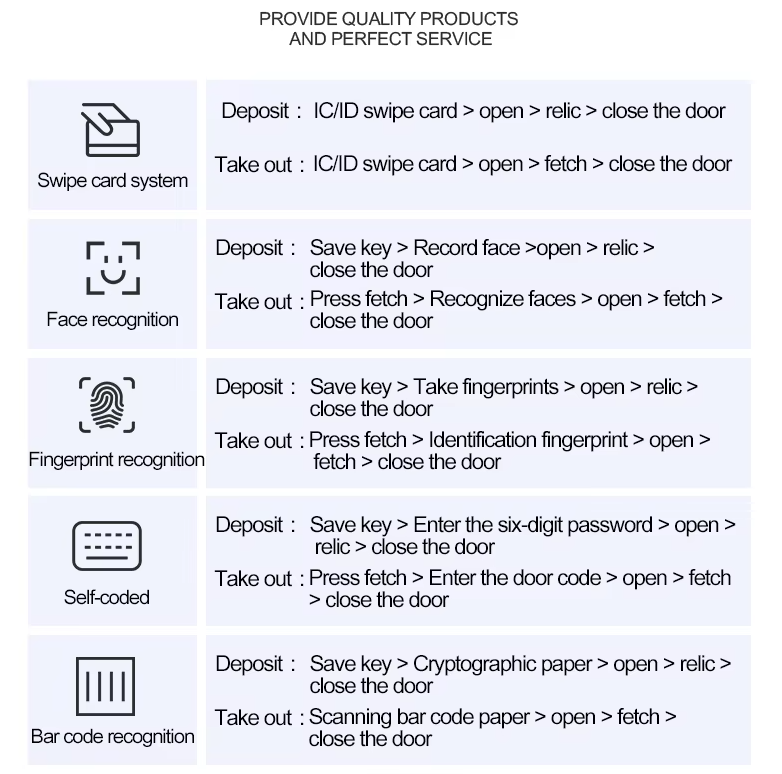
| Access type | Works for | Struggles with | Needs |
|---|---|---|---|
| Printed barcode slip | Visitors who hold nothing with you | Wet or creased paper | A printer and spare rolls |
| Contactless card | Staff, members, students | Visitors with no card | Cards you already issue |
| Fingerprint | Daily users, high-security rooms | Wet, cold or worn fingers | Enrolment at a desk |
| Face recognition | Hands-full, gloved or hygiene-sensitive sites | Changing light, masks | Enrolment at a desk |
In practice most British sites end up with a mix rather than a single type: cards for the people who work there, a slip printer for the people who visit.
Barcode: the only one that works on a stranger
A barcode locker asks nothing of the user in advance. They press deposit, a door opens, the printer gives them a slip with the code on it, and they come back later. No account, no card, no enrolment.
It is the right answer for receptions, leisure centres, hospitals and anywhere with a public-facing front door. The cost is paper: rolls run out, slips fade in a hot car, and somebody has to keep the spares at the desk. That is a process cost, not a product flaw, and it is worth counting before choosing this route. The mechanics are set out in barcode storage cabinets.
Card: the cheapest option if the cards already exist
Where a site already issues contactless IC cards, the reader is simply another device that reads them. No second account, no app, no registration queue.
Two card types still cause trouble in the UK market. Magnetic stripe cards are being retired and need a different reader. Phone-only access needs a different reader again. If the cards are contactless, post one to the supplier before the order rather than describing it in an email — a reader that rejects the cards your staff already carry is an expensive discovery.
The card-versus-key comparison, including how a lost card and a lost key differ in cost, is in card lockers for public buildings. Where there is no card system and none is wanted, mechanical key lockers do the same job for less.
Fingerprint and face: power without the queue, if there is a desk
Both replace the credential with the person, which is genuinely useful where keys and cards get lost, or where gloves and hygiene rules make touching anything awkward.
Both also require an enrolment step for every new user, and that step needs a human. A site with a staffed reception can absorb it in twenty seconds per person. A site with nobody on the door cannot, and will end up with a bank that only the first week’s users can open.
Door counts: twelve at a time
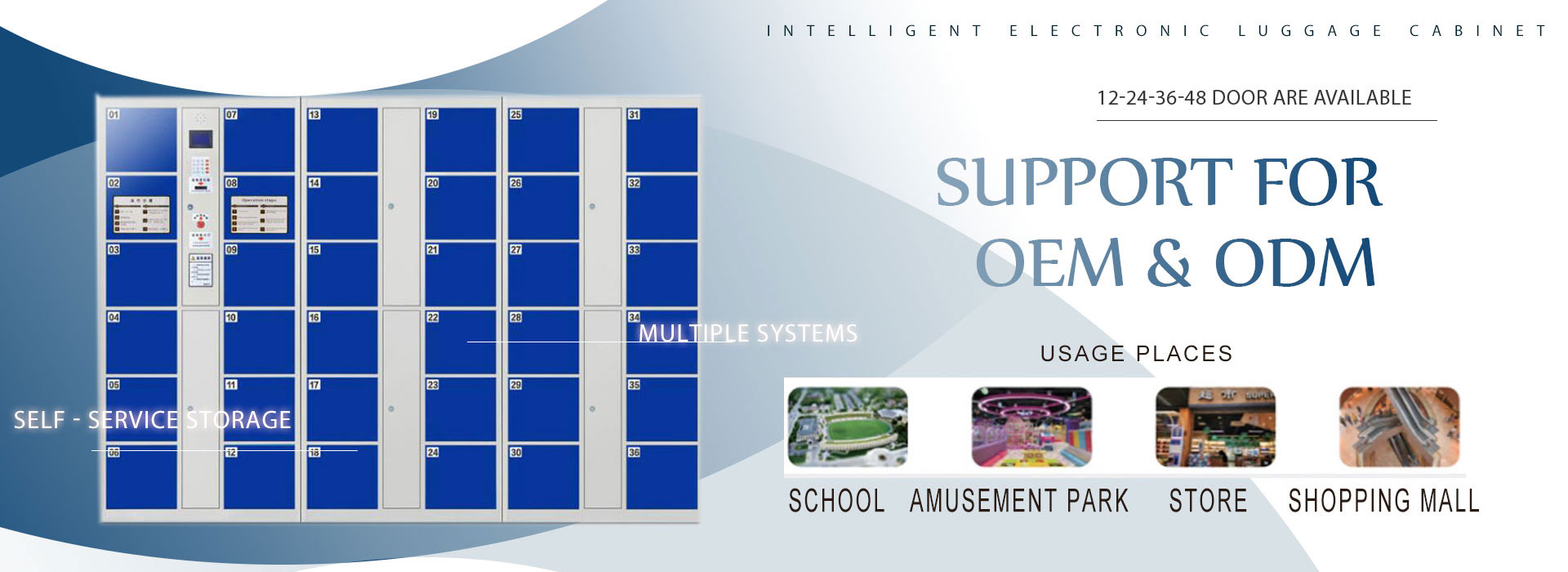
Twelve doors make one body, 850 mm wide, 1800 mm high and 460 mm deep, with a control column in the middle. A bank is two, three or four bodies: 24 doors at 1700 mm, 36 at 2550 mm, 48 at 3400 mm.
The number that decides it is the peak, not the daily total. Work out how many people are inside a compartment at the same moment during the busiest hour, and add doors until that figure is covered with room for the person who arrives with a colleague. The arithmetic is worked through, with four measurable numbers, in how self-service lockers cut waiting time.
Power, network and siting
- One earthed socket on the wall behind the cabinet. No dedicated circuit, no rewiring.
- No network connection is required. The controller keeps its own occupancy record.
- A flat floor and a wall. No plinth and no anchor bolts.
- A metre of clear floor in front, because an open door plus a person reading a slip is the space you actually need.
Indoors or under a canopy. A bank in direct rain collects water on the doors and puddles where people have to stand, which is a siting mistake rather than a product one.
What it costs to run, in staff minutes
Nobody budgets for the minutes, and they are the difference between a bank that works and a bank that gets switched off. Three jobs recur:
- Paper. A barcode printer with a slip per deposit goes through rolls faster than most sites expect. Keeping two spare rolls at the desk is the whole fix.
- Override. Roughly one user in a hundred turns up with a slip that will not read. Two minutes if the management code is at the desk, and a complaint if it is in an office upstairs.
- Clearing. A compartment left open at the end of the day, or a bag left behind. Five minutes, once the routine exists.
The mistake that shows up at commissioning
The common one is a reader fitted below the door line, so the person has to crouch to tap a card while holding a bag. It is obvious within a day of going live and expensive to change afterwards.
The second is a bank specified for a wall that turned out to be 40 mm short once the skirting was measured. Ask for the wall measurement including skirting, and for the socket height, before the drawing is signed rather than after the crates arrive.
Specifications
| Item | Value |
|---|---|
| Doors | 12 / 24 / 36 / 48, in bodies of 12 |
| Body size | H1800 × W850 × D460 mm |
| Single door | W270 × H300 × D460 mm |
| Access | Barcode slip, contactless card, fingerprint or face |
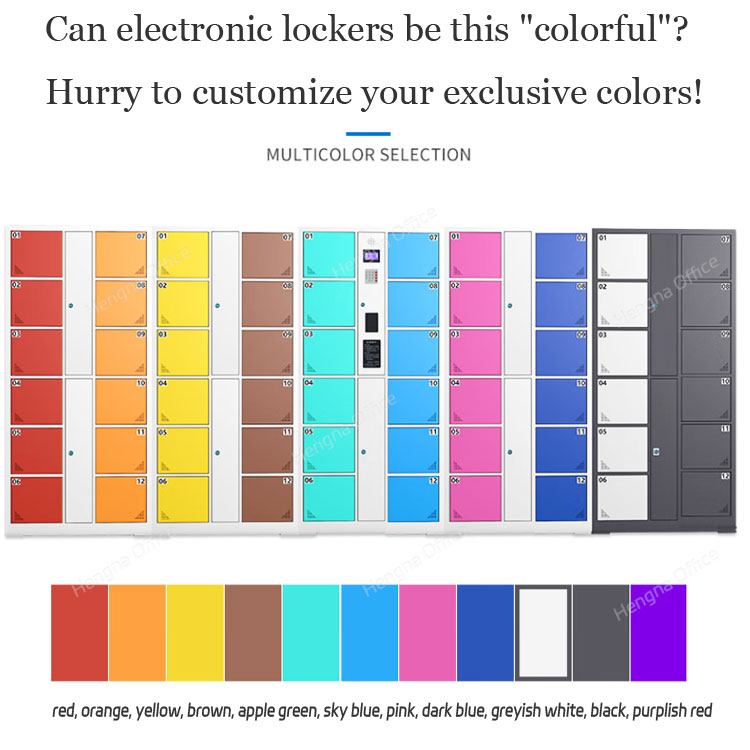
| Colours | White body with sky blue, police blue, orange-red or fruit green doors |
| Power | One earthed socket |
| Network | Not required |
What a UK buyer should send with an enquiry
- The peak hour count, or the daily footfall and average stay if you would rather we did the sum.
- Which credential: slip, existing card, or a mix of the two.
- One physical card, if a card reader is in scope.
- A photo of the intended wall, including the socket position.
The door count and the finish come back with the quotation, and the loading plan with it.
Where the requirement differs slightly, the options are covered in fingerprint locker for hotels.