Ten to seven in the morning, housekeeping briefing. Forty people, one key board, and a queue in front of it. One hook is empty — the key went home with someone on the late shift — so two attendants are waiting while the supervisor works out who has it.
By the time the trolleys leave the floor, five minutes of a fifteen-minute briefing are gone and nobody has talked about the rooms yet. This happens in hotels that are otherwise well run, and the key board is the reason.
Housekeeping is a shift business with high turnover. Any storage system that depends on a named person keeping a named piece of metal is going to fail on the days it matters most.
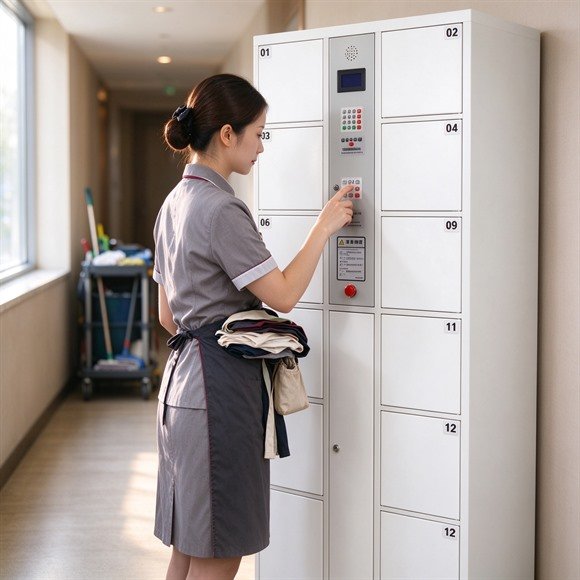
Why key handover breaks down in housekeeping
- Staff change more often than lockers do. Seasonal hires, agency staff and shift swaps mean the name on the key hook is wrong within a month. Then the board stops being a system and becomes a suggestion.
- The briefing becomes a key queue. One person handing out forty keys takes minutes you do not have, twice a day.
- A lost key is a lock change. On a floor with guest rooms, a missing key is a security question, not an inconvenience — and it usually turns up after the lock has been replaced.
- Nobody wants to admit they lost it. So the key is quietly borrowed from another floor’s board, and now two keys are unaccounted for.
How a code locker changes the morning
With a self-set PIN locker bank, nobody hands out anything. The attendant walks up, presses a button, picks a free compartment, types a six-digit code she chooses, and puts her kit in. At the end of the shift she opens it with the same code, takes her things, and the compartment is released — the code clears when the locker is freed, so the next person sets their own.
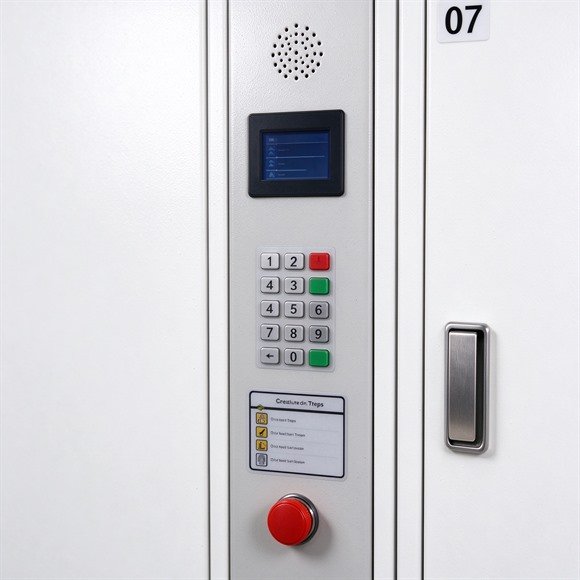
Three things follow from that, and they are the whole argument:
- No handover. The briefing starts with rooms, not with keys.
- No names on hooks. Compartments are taken as needed, so agency staff and shift swaps need no administration at all.
- No lost-key lock change. A forgotten code is handled by the supervisor on site, from the cabinet, without calling anyone out.
Sizing a bank for a housekeeping team
Count the biggest shift, not the payroll. In most hotels the morning shift is the peak, and a bank sized for the morning covers every other shift with room to spare.
| Doors | Overall size H×W×D (mm) | Typical fit |
|---|---|---|
| 12 | 1800 × 850 × 460 | Small boutique property, one floor team |
| 18 | Made to order | Mid-size property, single shift team |
| 24 | 1800 × 1700 × 460 | Full-service hotel, morning shift peak |
| 36 | 1800 × 2550 × 460 | Large property or two departments sharing one room |
If the team size swings between seasons, the sum is worth running twice — the formula works from the shift peak rather than the payroll.
What actually fits inside
This is the part worth getting right before you order, because it decides whether the staff use the lockers or work around them.
Each compartment is roughly 270 mm wide, 300 mm high and 460 mm deep. That takes a folded uniform or apron, gloves, a phone, a small bag and a pair of flat shoes — the kit most housekeeping teams actually carry to a shift.
Housekeeping kit is folded, not hung — a tunic, an apron, a spare pair of gloves and a phone go in as one stack, and the door closes flat. That stack is what the 270 mm width and 300 mm height were sized around, and it is why a compartment bank suits a shift team better than a wardrobe: nothing inside needs swinging room.
What the cabinet needs on site
- Power. One connection at the bank. The cabinet is assembled and tested before it ships, so on arrival it is positioning, levelling and plugging in — not a build.
- A level floor. Doors that hang out of square jam, and a jammed door in a staff room becomes a propped-open door by the end of the week.
- Cold rolled steel with a phosphate pre-treatment and powder coat. Staff rooms are cleaned daily and a coated panel takes a wipe without the finish lifting.
- LCD screen and voice prompts. The step-by-step guidance matters for new starters who have never used a code locker.
- Mechanical emergency key for the supervisor. Kept in the duty manager’s office, not on the floor.
- Power-loss memory on models that carry it. Assignments survive a brief outage instead of releasing every door.
That list is shorter than most hotel projects expect: one socket, a level floor, a wall. The four requirements are written out in full here.
Five checks before you order
- Peak shift, not total headcount. A 120-person department with a 60-person morning shift sizes on the 60.
- Kit, not job title. Ask three attendants what they actually bring to a shift. Folded tunic, apron, gloves, phone, flat shoes — that stack is what the compartment is sized for.
- Who can open a compartment. One named person per shift, one emergency key, one written rule.
- Cleaning between shifts. A code bank is personal-use, not guest-use: a wipe-down at the end of each shift is a five-minute job and stops the smell problem before it starts.
- Where it stands. Beside the linen room or at the end of the service corridor, on a dry level floor, not against a wall that runs with condensation.
Questions from hotel engineering and HR teams
What if a staff member forgets her code?
The supervisor opens the compartment with the mechanical emergency key, checks who is on shift, and the compartment is released and re-coded. No lock change, no locksmith.
Can the same person keep the same compartment every day?
The cabinet works on release-and-recode: codes clear when a compartment is freed, and the next user sets their own. That suits shift work and agency staff, where a fixed assignment creates more admin than it saves.
Is the code secure enough for staff belongings?
Each compartment has its own electronic lock and a code only the user sets. It is staff-room storage, not a safe: cash, jewellery and personal documents belong in the office safe, and it is worth saying so at the briefing.
Can the screen text be in our language?
Yes. The LCD text, the voice prompts and the manual can all be produced in the local language as part of the order.
What about a power cut during a shift?
Doors stay closed and the supervisor’s mechanical key still works. On models with power-loss memory, assignments survive the outage; a backup power connection is available as an option.
What to send us
Send the peak shift headcount and a photo of the wall where the bank would stand. That is enough to come back with a door count, a layout and a quote within 24 hours. MOQ and lead time are confirmed with the quotation, because colour and language customisation change both. CE certification is available, and OEM and ODM work covers logo, screen language and the manual.
Need somewhere to hang coats outside the locker room, or two access methods in one corridor? The mechanical key changing lockers carry a hanging rod and a shelf for outerwear, and the electronic locker range covers barcode and card entry beside the keypad bank.