A vocational school dormitory has a real storage problem — 4 to 8 students in one room, not much space per person, and furniture takes a beating. Most budget lockers start wobbling and jamming within two years. That’s not bad luck. It’s the wrong product.
This 4 door steel locker is built for exactly that kind of heavy daily use. Cold rolled steel body, KD flat pack design, four independent compartments. Four students share one unit, and the per-person cost is about a quarter of what you’d pay for four single lockers. Factory direct, no middlemen.
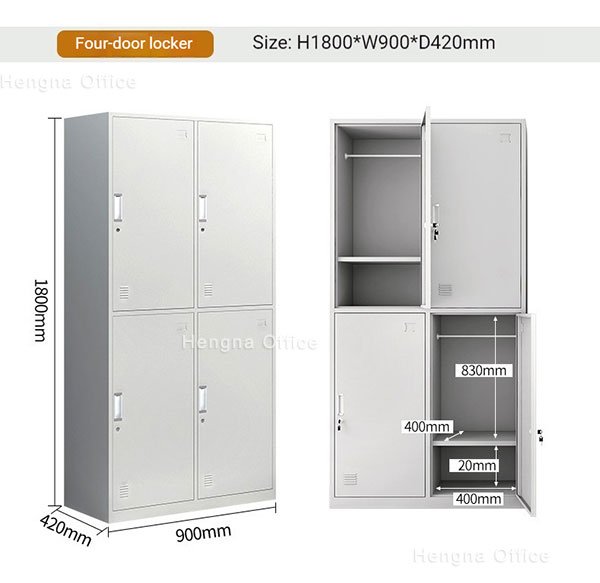
4 Door Steel Locker for Vocational School Dormitory Product Specs
| Spec | Detail |
|---|---|
| Product | 4-Door Steel Locker |
| Overall Size | H1800mm × W850mm × D420mm |
| Internal Layout | 4 compartments, 2 upper + 2 lower, each with separate door |
| Material | Cold rolled steel |
| Finish | Electrostatic powder coating, matte white |
| Structure | KD flat pack |
| Container Load | 800+ units per 40HQ |
| Hardware | Aluminum alloy handle + individual key lock + stainless steel hanging rod |
| Optional | Interior door mirror / number plates / name tag slot |
What Makes This Locker Different
Cold rolled steel — not just a material, a difference that shows up over time
Plenty of lockers on the market use hot rolled steel. It’s 20-30% cheaper, but the surface is rough, powder coating doesn’t grip well, and within a year or two, paint starts peeling at the edges. Cold rolled steel gives you a smooth, even surface. Powder coating bonds properly. Under normal use, the finish holds up for 6-8 years without peeling.
Then there’s dimensional accuracy. Students open and close doors with zero care. A hot rolled steel locker with loose tolerances ends up with uneven door gaps and doors that sag and jam. Cold rolled steel holds tighter tolerances across production runs. Doors line up, hinges stay smooth, and the cabinet keeps working through one graduating class after another.
Load-bearing matters too. Cold rolled steel shelves support up to 25 kg per compartment — enough for textbooks, backpacks, and a season’s worth of clothes. Hot rolled shelves manage barely half that before they start bending.
KD flat pack — not a cost-cutting shortcut, it’s the smart way to ship
People sometimes assume KD knock-down construction is a budget compromise. For export projects, it’s actually the most practical choice.
Fully assembled lockers eat up 30-45% of total project cost just in shipping. Flat pack brings that down to 15-20%. Each unit ships as stacked panels — side panels, door panels, top and bottom boards, back panel, shelves — wrapped in moisture-proof film, packed in 5-layer corrugated cartons with hard corner protectors. Arrives at port damage-free.
One 40HQ container holds under 250 fully assembled lockers. Flat packed, it holds 800+. When you’re shipping by volume, that’s a 3x difference in per-unit freight cost. For a project of several hundred lockers — typical for a vocational school dormitory — the shipping savings alone can cover the cost of another batch.
At the destination, two people with a Phillips screwdriver can assemble one unit in about 40 minutes. We supply an installation video that works offline (save it to a phone), plus a printed diagram in the package. Each flat-packed module weighs 15-20 kg, so one person can carry it up a staircase — no elevator needed.
Locks and hardware — the small stuff that makes the difference
Every compartment has its own brass-core key lock. Brass cylinders last 3-4 times longer than iron-core ones. Students unlock their lockers 3-5 times a day. An iron lock starts catching after 1-2 years. A brass one still turns smoothly at year 4 or 5. Interchange rate is extremely low — out of 3,200 locks across 800 units, the chance of any two keys matching is negligible.
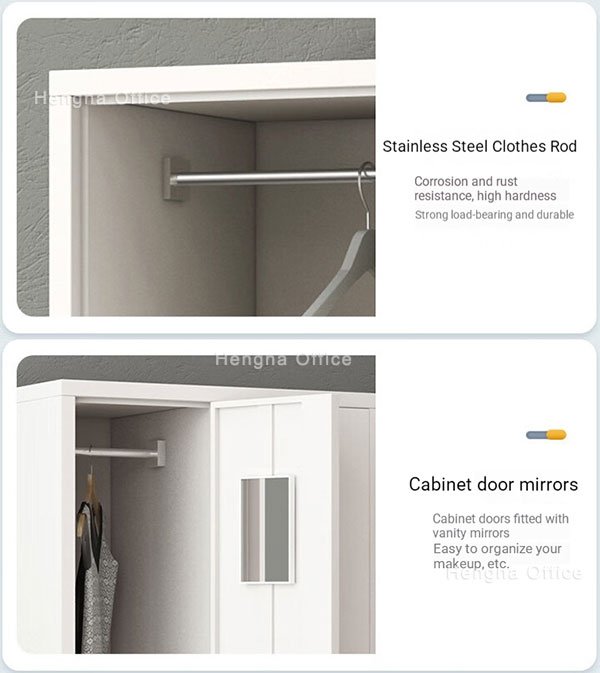
Each compartment has a stainless steel hanging rod rated for 20 kg. Guard 304 stainless, passed 72-hour salt spray testing with zero rust spots. In dormitory use, students hang damp clothes and towels. An iron rod starts rusting within six months, and the rust drips down onto clothes and the shelf below, leaving yellow stains that never come out. For students on a tight budget who can’t just replace a locker, this matters a lot.
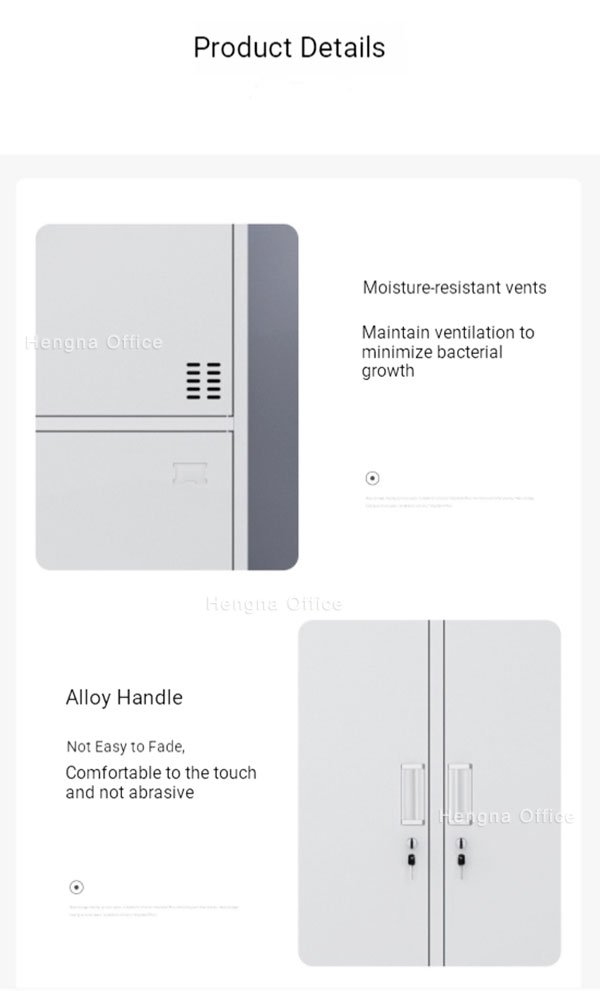
Below each door, there’s a long slot vent. Air circulates naturally through the upper and lower compartments. Four people’s clothes packed together need that airflow — otherwise you get that damp, stale smell when you open the door.
Aluminum alloy recessed handles with anodized finish. Won’t discolor or oxidize. Edge chamfers so you don’t catch your hand or shirt on them. No exposed iron handles that rust and scratch people walking past.
Powder coating — we don’t just spray and call it done
The steel goes through degreasing, acid washing, and phosphating before electrostatic powder coating. Final coating thickness: 60-80μm, with uniformity within ±10μm. Passes 2H pencil hardness — daily bumps and scratches from students won’t expose bare metal. 48-hour moisture resistance test: no blistering, no peeling.
In plain terms: cheap powder coat starts chipping off in two years. This one still looks clean at year six.
Where It Works — and Where It Doesn’t
Good fit:
- Vocational and technical school dormitories — 4 students per unit, standard configuration
- Factory changing rooms in Southeast Asia, East Africa — employees changing into work uniforms, bulk orders
- Private hospital staff rooms — doctors and nurses one compartment each, clean and durable
- University dorms and training centers — frequent turnover of users, needs to last
Not a fit for:
- Outdoor open-air placement — no weatherproofing
- Poolside changing rooms — extreme humidity calls for stainless steel
- Storing cash, valuables, or sensitive instruments — upgrade to combination or electronic locks
Assembly
Each unit ships with: Side panels ×2, Doors ×4, Top board ×1, Bottom board ×1, Back panel ×1, Middle shelves ×3, Stainless steel hanging rods ×4, Screw kit + keys.
Tools needed: one Phillips screwdriver. Assembly time: about 40 minutes for one person.
For bulk orders, we provide: installation video (save offline), printed diagram manual, and a missing-parts guarantee so nothing holds up your project.
FAQ
How much fits in one compartment? Roughly 0.6 cubic meters. Holds 3-4 jackets a backpack and shoes comfortably. Use the upper shelf for bedding and bags, the hanging rod for daily clothes.
Steel locker vs plastic locker — which should I pick? Steel wins on strength and fire resistance by a mile. Plastic is lighter and cheaper upfront. For dormitory or any shared-space setup where durability matters, steel is the better long-term play. Plastic works if it’s a short-term temporary setup.
Does it need to be bolted to the wall? No. The locker stands stable on flat flooring. If you’re worried about students tipping it, anchor it to the wall with expansion bolts — the installation video covers that.
Can I order one sample before placing a bulk order? Yes. We can ship a trial unit or mix a few models in one small shipment so you can inspect quality before committing. Contact us for details.
Does the metal smell? New lockers have a faint smell that clears after 2 days of airing. Low-temperature curing powder coat, not standard baked paint, means much less odor than paint-finished cabinets.
Lost the key? Each compartment comes with 2 keys. We can supply replacements if you give us the key number on the lock.
Do you ship internationally? How is it packed for sea freight? Yes. FOB and CIF available. Three layers of protection: moisture-proof PE film inner wrap + 5-layer corrugated carton + hard corner protectors. Sealed against container condensation. Arrives clean and rust-free at your port.
Get a Quote
School dormitory locker projects are about finding the right balance between budget and something that won’t fall apart before the next intake. If you have a project with specific dimensions, quantities, or delivery requirements, reach out. Tell us what you need — we’ll put together a proposal. No obligation, just a conversation.
Contact us for a quote →