Six in the morning, two hundred workers coming through the gate, and the electricians are standing outside the site office because the key to their locker went home in the foreman’s van. Twenty minutes of paid time, gone. It happens again on Thursday.
That is not a storage problem. It is a key problem, and it shows up wherever storage gets improvised: a chain through the handles, one padlock for forty people, a plastic crate under a bench that nobody wants to touch by the second week.
The fix is unglamorous. Give each crew its own compartment, put a number on every door, and decide the door count before the container leaves — not after the bank is standing in the compound with the wrong split.
Where site storage actually breaks down
Four patterns come up every time we are asked to sort out a compound already in use.
- One lock, forty people. Nobody can say who left the door swinging, so nobody closes it. Bent doors are the first thing you notice and the easiest thing to prevent.
- Keys travel home. One crew leader keeps the key on his van ring, the van goes to another site, and the crew works out of a bag for three days.
- A lost key becomes a broken door. Somebody finds the bolt cutters, the door never sits flush again, and the repair costs more than the lock did.
- Wet gear goes in with clean clothes. Hi-vis and boots come back soaked, get stacked on a spare shirt, and by Friday the compartment smells like a drain.
One compartment per crew, one number per door
Forget headcount for a minute. Storage on a construction site is almost never organised per person — it follows the crew, because that is how work is issued, how tools are signed out and how the gate list is written. A four-door bank covers four crews. A nine-door bank covers nine. Each door gets a number, and the number goes on the crew list taped inside the office.
That single change settles most of the arguments. A crew with a number and a key has something to lose. A crew sharing an open shelf does not.
| Model | Doors | Size H×W×D (mm) | Net weight | Flat-pack volume |
|---|---|---|---|---|
| Two-door changing locker | 2 | 1850 × 900 × 500 | 43.4 kg | 0.155 m³ |
| Four-door changing locker | 4 | 1850 × 900 × 500 | 46 kg | 0.155 m³ |
| Six-door changing locker | 6 | 1850 × 900 × 500 | 50.6 kg | 0.155 m³ |
| Nine-door changing locker | 9 | 1850 × 900 × 400 | 44 kg | 0.14 m³ |
| Twelve-door changing locker | 12 | 1850 × 900 × 400 | 47 kg | 0.14 m³ |
| Fifteen-door changing locker | 15 | 1850 × 900 × 400 | 50 kg | 0.14 m³ |
Those volumes are the freight argument. A four-door bank ships flat at 0.155 m³ and a nine-door at 0.14 m³, so a container holds several times the number of units an assembled cabinet would allow. On a site order of forty banks, that difference lands in the freight line, not the product line.
What the cabinet is built from
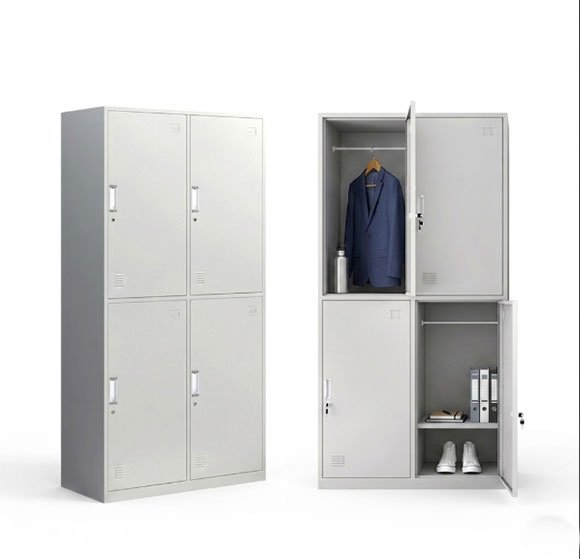
- Cold rolled steel, with the gauge made to order. Cold rolled holds its shape better than hot rolled, which is the panel that starts rusting along the bottom edge in a humid compound.
- Electrostatic powder coating in three colour sets — grey-white, curry-white and pure white — so one order can match two or three blocks without a separate paint run.
- Narrow-edge frame. Less folded steel showing around each door, which is why the bank reads lighter than its 46 kg.
- Ventilation slots in the door. Wet hi-vis needs somewhere to breathe or the compartment turns into a smell problem by week four.
- Hanging rod and a shelf inside each compartment: boots on the floor, coat on the rod, clean clothes on the shelf.
- Individual key lock per door with a recessed alloy handle that does not catch on trolleys.
Running the key register
One key per door is only half the system. The other half is the register, and it costs nothing to run:
- Number every door and put the number against the crew on the office list.
- Keep the spare key for each door in a sealed envelope, in the office, sorted by number.
- When a crew changes, change the key with the crew — a new cylinder is a small line item next to a door that has been forced.
- Write the key handover on the same sheet as the gate pass. One sheet, one signature, no argument.
The door count is usually the last thing to settle, and it moves the price more than any option does. If that number is still open, the headcount method with three worked examples takes about ten minutes.
Five checks before you order
- Crews, not headcount. Write the trade list first. The door count follows from it.
- Depth: 400 or 500 mm. The four and six-door banks are 500 mm deep; nine doors and above are 400 mm. Deeper suits bulky PPE, shallower keeps the walkway clear.
- Where the bank will stand. Under a stair, inside a container and against an outside wall are three different environments. Any steel cabinet wants a level, dry base.
- Delivery route. A four-door bank ships as a panel pack of roughly 1880 × 1030 × 85 mm. That goes through a standard doorway; an assembled bank does not.
- Colour split. Three sets are standard, and the same model in any of them. Decide the split now if two blocks need different colours.
Where the argument is keys against cards and printed slips rather than against nothing, that decision is worked through step by step in this comparison.
Questions we get from site managers
How many compartments does one construction crew need?
One. A crew of ten shares a compartment, hangs jackets on the rod and puts boots on the floor. Crews carrying personal tool bags usually want two so the bag does not sit against wet clothing.
Does each door have its own key?
Yes. A crew opens its own compartment and nobody else’s. Spares stay in the office sorted by door number, and a new cylinder is a small line item next to a forced door.
Will wet workwear damage the cabinet?
Not the steel. What damages any steel cabinet is standing water at the base, which attacks the bottom edge. Ventilation slots let the inside dry out and a dry level base keeps the panel off the floor.
Does it arrive assembled?
Flat pack. A four-door unit ships in one panel pack of about 1880 × 1030 × 85 mm and assembles with hand tools. It also means a bank can go up a stair or through a doorway that an assembled cabinet would never fit.
Can the doors be numbered and labelled?
Yes — number plates or name tag slots are set at the order stage, so the numbering matches the crew list on day one rather than being stencilled on later.
What to send us
Two things are enough for a real answer: the crew list and where the bank will stand. From that we work out door count, depth, colour split and delivery form, and reply with a quote within 24 hours. CE certification is available, and OEM and ODM work on logo, packaging and manuals is part of the same order. If the site is still on paper, send the layout drawing — door counts are easier to fix on a drawing than in a compound in its second week.
Still weighing key locks against electronic access? The mechanical key locker range covers the key side, and the electronic locker systems cover barcode, card and biometric entry when a site needs both.