The Warehouse Office Is Not a Regular Office
A warehouse office is a different environment.The floor is concrete, not carpet. Dust is a fact of life. The printer might be in a shipping office that doubles as a receiving desk. The person using it might be wearing gloves. The printer might be shared between three shifts. Paper consumption is high. Space is often tight.The Hengna industrial printer cabinet was built for these conditions — not repackaged from a standard office product line, but designed with the warehouse office environment in mind.
Industrial Steel Printer Cabinet — Floor Standing Construction Details
Steel that handles industrial conditions
The cabinet body is made from Baosteel Grade-1 cold-rolled steel. This is not commodity steel — it has consistent thickness, clean surface quality, and high resistance to deformation under load. In an environment where the cabinet might be bumped by equipment, leaned against, or exposed to temperature variation, Grade-1 steel holds its shape.
Industrial casters for concrete floors
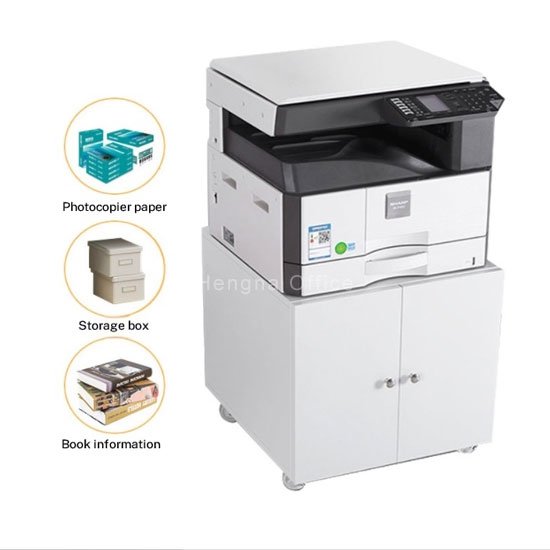
The caster wheels are hard nylon with steel hubs. They roll smoothly on concrete, which is the standard floor surface in warehouse and workshop environments. The brake locks engage firmly on flat concrete — the unit does not drift or shift during use.
Powder coating that handles dust and moisture
The matte white powder coating seals the steel against moisture and dust infiltration. In a warehouse environment where humidity varies and dust is constant, a sealed powder-coated surface does not flake, rust, or corrode the way standard paint does.
Anti-slip guards on every shelf
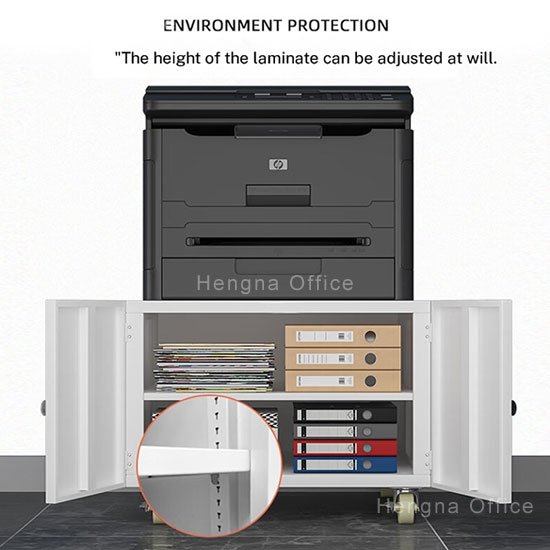
The anti-slip edge guards on all shelf surfaces are particularly important in industrial settings. If a forklift or pallet jack vibration travels through the floor, unsecured items on an open shelf will shift. The edge guards prevent this.
Who Uses the Industrial Steel Printer Cabinet
Scenario 1 — Shipping and receiving office
The shipping office at a distribution warehouse runs 200–500 labels per day. Shipping forms, customs paperwork, and receipt documentation all print from one central printer. The Model 2 sits beside the shipping desk, holds a week’s worth of label stock and paper in the storage bay, and has the printer at standing height for fast label collection.
Scenario 2 — Workshop maintenance office
A maintenance workshop has a small office section with two staff members. They print service reports, parts order forms, and safety checklists. The printer sits on a Model 1 beside the desk. The lower shelf holds a ream of paper and a box of toner. Everything is within reach. Nothing is on the desk.
Scenario 3 — Manufacturing plant admin area
A mid-size manufacturing plant has an admin office at the edge of the production floor. The printer is used by three shifts. The Model 2 holds supplies for all three shifts — the night shift does not need to ask the day shift to restock paper. The casters let the cleaning crew move the unit for weekly floor cleaning.
Scenario 4 — Auto repair shop service desk
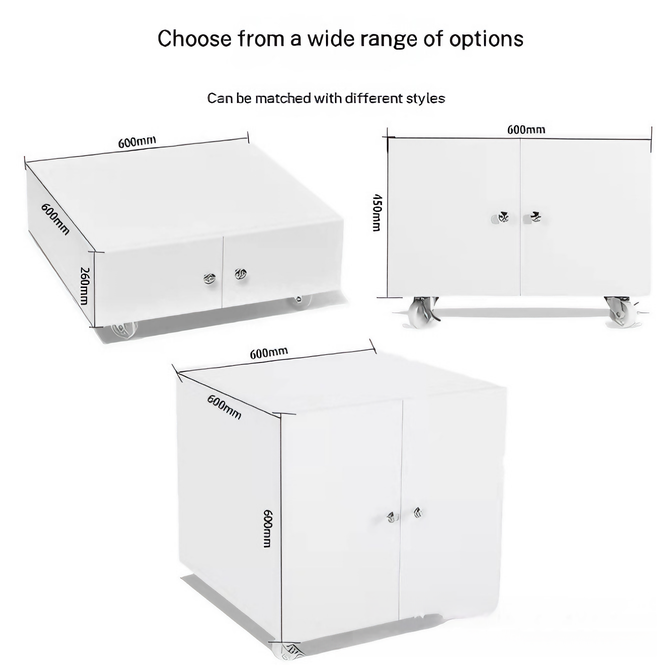
Auto repair shops print invoices, work orders, and parts quotes. The service desk is often narrow. A Model 3 (450mm wide) fits in the narrow space beside the service desk without blocking the walk-through aisle. Paper and forms live inside. The printer sits on top at counter height.
Workspace Integration Options
The Hengna industrial cabinet integrates with warehouse office layouts in two primary configurations:
Configuration A — Beside the desk (Model 1 or 3)
For narrow workspaces or single-person stations:
- Model 3 (450mm wide) fits beside most standard desks without blocking access
- Printer sits at hip-height, at the same level as the desk surface
- Lower bay holds one to two ream boxes
Configuration B — Standalone print station (Model 2)
For dedicated copy/print areas or high-volume stations:
- Model 2 provides standing height access and maximum storage
- Holds full paper boxes flat, multiple toner cartridges, and supply items
- Can serve as a workstation side table when combined with a simple flat-top addition
Cleaning Protocol for Industrial Environments
Industrial cabinets in warehouse settings require a different maintenance approach than office furniture:
Weekly:
Move the unit aside (unlock casters) and sweep/vacuum the floor beneath and behind. Check caster function — confirm both brakes engage and release cleanly.
Monthly:
Inspect all exterior surfaces for dust buildup. Wipe with a damp cloth. Check caster wheel surfaces for debris wrapped around the axle — remove any string, tape, or packaging material that may have accumulated.
Quarterly:
Check all bolts and joints for tightness. In vibration-heavy environments, bolts can loosen over time. Tighten as needed.
Annual:
Inspect the powder coating for chips or scratches. Touch up with a matching appliance enamel if needed. Not strictly necessary for function, but extends appearance quality.
Frequently Asked Questions
Q: Are these casters suitable for outdoor or semi-outdoor warehouse areas?
A: The standard casters are designed for indoor hard floors. For outdoor or semi-covered loading dock areas, consult with us about heavy-duty outdoor caster options. Standard casters in outdoor conditions will wear faster and may accumulate debris in the wheel mechanism.
Q: Can the cabinet be anchored to the wall?
A: The Model 2 has pre-drilled mounting holes on the rear panels for wall anchoring. This is recommended in high-vibration environments or where the unit should not be moved. Wall anchor hardware is not included.
Q: What is the maximum load for the Model 2 in an industrial setting?
A: The 70KG total load rating (including contents) applies. In a vibration-heavy environment, keep the load distributed evenly and avoid top-heavy configurations (heavy items on upper shelf, nothing on lower bay).
Q: Can I order these in bulk with custom colors for our facility?
A: Yes. Custom colors and custom branding (company logo on the door panel) are available on orders of 10 units or more. Contact us for a custom quote.
Q: Is the interior shelf adjustable on the industrial model?
A: Yes — identical to the standard Model 2. The shelf adjusts in 260mm increments using pre-drilled mounting holes.
Q: What is the delivery process for industrial orders?
A: Units ship flat-pack via freight carrier for orders of two or more units. Single units ship via parcel carrier. Freight delivery includes curbside drop only — liftgate service available on request.
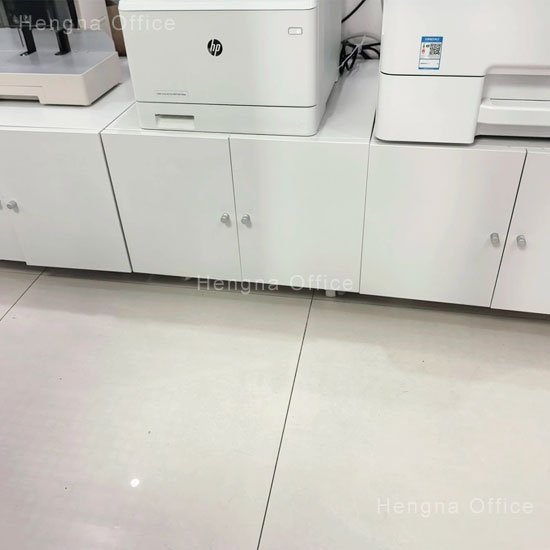
Real User: Auto Parts Distribution Center
“Our receiving office is about 3 meters square. We needed a printer solution that didn’t take up desk space. The Model 2 sits beside the door — we walk in, grab our printouts, and go. It holds all our paper and forms. Staff stopped complaining about the printer situation.”
— Marcus L., Logistics Supervisor, Houston, TX
“We have it locked down with the brakes on at all times. Once a month we sweep under it. It’s survived two years in a warehouse environment and it still looks decent.”
— Marcus L.
Why the Industrial Cabinet Is Worth the Investment
A standard office printer stand in a warehouse environment will rust, chip, and deteriorate within 12–18 months. The Hengna industrial cabinet, built with powder-coated steel and industrial casters, is designed to handle the conditions that standard office furniture cannot.
The investment difference is real — but so is the replacement cycle. One Hengna industrial cabinet in a warehouse office typically outlasts two to three standard office units.