A retail backroom has two shifts, a narrow corridor, and a wall that was never designed to hold anything. The staff changing area is usually the last two metres of that corridor, and whatever goes there has to survive wet coats, cardboard boxes being dragged past, and a store refit every three years.
A six-door bank is the size that fits that wall. Here is what it holds, why the vents matter more than the paint, and what assembly actually involves.
Six doors, and why six
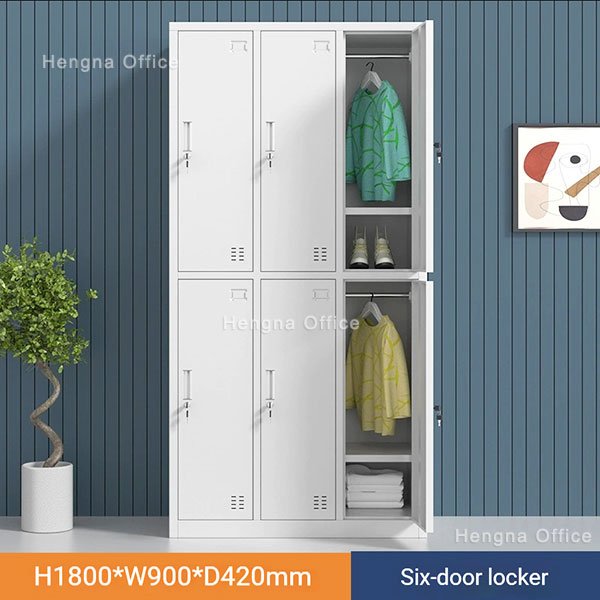
One body, 1800 mm high, 900 mm wide, 420 mm deep, split into six compartments in two columns of three. That is six people per body, which matches a shift change in a small store and lets a manager give each person a door rather than a shelf.
It also fits where a wider bank does not. Six doors at 900 mm takes a wall segment that a 24-door bank would consume four times over, and in a backroom the wall is the constraint, not the headcount.
Where the room takes a wider bank, the same body exists with four doors: four-door steel changing lockers. And where the site wants to issue one key per person with no electronics at all, that side of the range is under mechanical key lockers.
What one compartment holds
Each compartment is roughly 580 mm high, 300 mm wide and 400 mm deep, which is a folded uniform, a pair of shoes, and a bag on the shelf — the working contents of a retail shift.
Two things do not fit and are worth saying out loud before the order: a full hiking rucksack, and a crash helmet. Staff who cycle to work will want one of those, so a store with a cycling contingent should plan a taller compartment or a shelf elsewhere.
Ventilation is the feature that decides whether staff use it
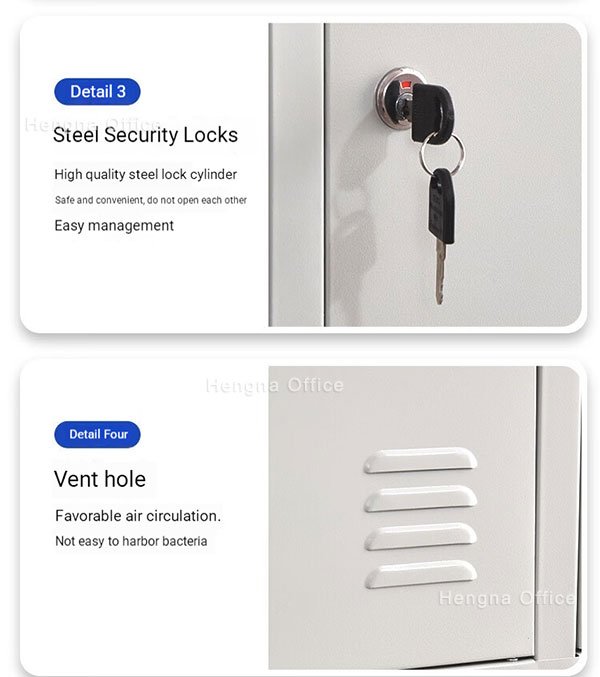
A steel box with a wet coat in it smells like a steel box with a wet coat in it by Thursday. Both louvred vents at the top and a set of holes at the bottom matter, because a single vent at the top leaves the damp air sitting in the base of the compartment.
The same airflow is why the doors do not rust from the inside out, which is the failure that actually ends a locker’s life in a damp backroom. It is also the reason not to seal the doors with tape to stop them rattling.
Locks: one door, one key
Each compartment has its own mechanical key lock. Nobody holds a key to all six, and there is no arrangement under which one key opens the whole bank — that is not a service offered, and it is worth knowing before someone asks for it.
The practical consequence is a key register, kept by whoever runs the backroom. Six keys, six names. It is a short list, which is the reason a six-door bank stays manageable while a twenty-four-door one does not.
Hanging rod and the interior
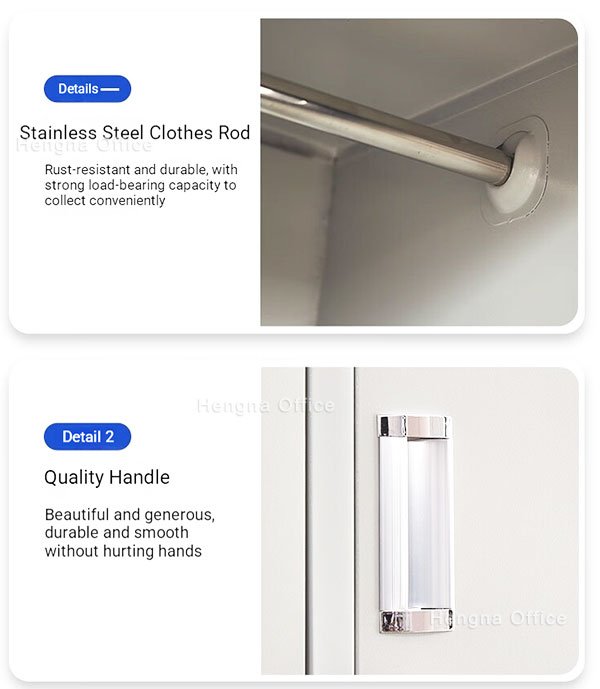
A stainless steel rod across the top of each compartment, a shelf above it, and a hook position on the door. The rod is stainless because a coated rod flakes at the fixing points within a year in a humid room, and then the flakes end up on a uniform.
The interior is bright, unfinished steel. Not decorative, but it makes the inside of a compartment visible when the door is open, which is what stops things being left behind at the end of a shift.
Flat pack: what it means on delivery
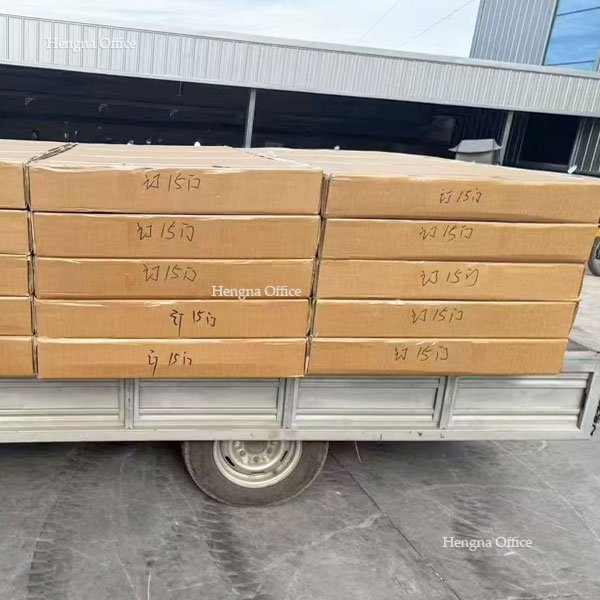
The body ships as flat panels — sides, doors, top and bottom, back, shelves — wrapped in moisture film, corner protectors on the edges, and cartons that stack.
- It goes through a standard back door and up a stairwell, which an assembled 1800 mm cabinet will not.
- It stores flat in a stockroom until the fit-out weekend, instead of occupying the corridor.
- Two people assemble a body in about forty minutes with the printed diagram.
- Panels are wrapped so the powder coat survives a lorry and a loading bay.
The one thing flat pack does not forgive is a missing part. Count the panels against the diagram before assembly starts, not halfway through.
Why not a twelve-door bank
Twelve doors is the next size up, and it is the right answer for a store with twenty staff on shift. It is the wrong answer for a backroom with a two-metre wall, because the bank simply does not go there.
The size that fits the wall is the size that gets used. A six-door body against the wall by the staff door will be full every day; a twelve-door bank that had to go in the stockroom because it did not fit the corridor will be half empty and in the way of the pallet truck.
What wears out first
Not the body. In a backroom the order of failure is predictable, and knowing it is what makes the maintenance budget realistic.
- The lock, or the key. A cam lock that is forced with the door half-aligned will fail before the steel does. It is a five-minute swap.
- The door alignment. A backroom floor that slopes means one column of doors catches on the frame. Levelling the body at installation prevents it.
- The paint at the toe. Trolleys and pallet trucks hit the bottom rail. A touch-up pen once a year keeps a bank looking like furniture rather than salvage.
Specifications
| Item | Value |
|---|---|
| Model | HN-LK6D-MF |
| Doors | 6 (2 columns × 3 rows) |
| Overall size | H1800 × W900 × D420 mm |
| Compartment size | Approx. 580 × 300 × 400 mm (H × W × D) |
| Body | Cold rolled steel, gauge to suit the project |
| Finish | Degrease, phosphate, electrostatic powder coat |
| Lock | Individual mechanical key lock, one per door |
| Interior | Stainless steel hanging rod, shelf, door hook |
| Ventilation | Louvred vents top and bottom |
| Packing | Knocked down, flat packed, moisture film and corner protectors |
What to send with an enquiry
- How many people per shift, since that sets the door count faster than the floor plan.
- Whether uniforms go on hangers or folded — it changes the shelf-to-rod balance.
- The wall dimensions and whether the delivery route has a lift.
- The finish: standard is a white body, and the door colour is usually chosen to match the store.
The bank size, the finish and the delivery schedule come back with the quotation.
A broader view of the same category is in digital storage lockers.