Factory changing room buyers usually face two choices: go cheap with plastic lockers that crack and warp within two years — paying twice for replacements plus labor — or buy imported steel lockers where the shipping costs more than the cabinets themselves.
This 4 door steel changing locker was designed to dodge both traps. Cold rolled steel body, KD flat pack construction, 800+ units per 40HQ container. Four people share one unit, factory direct pricing with no middlemen. For growing industrial markets across Southeast Asia, East Africa, and Central Asia where new factories are being built, the shipping savings alone can go toward better hardware and finish.
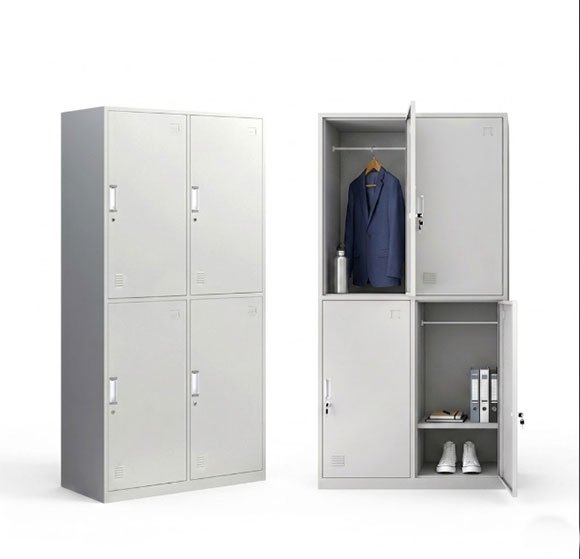
4 Door Steel Changing Locker for Factory Product Specs
| Spec | Detail |
|---|---|
| Product | 4-Door Steel Changing Locker |
| Overall Size | H1800mm × W850mm × D420mm |
| Internal Layout | 4 compartments, 2 upper + 2 lower, each with separate door |
| Material | Cold rolled steel |
| Finish | Electrostatic powder coating, matte white |
| Structure | KD flat pack |
| Container Load | 800+ units per 40HQ |
| Hardware | Aluminum alloy handle + individual key lock + stainless steel hanging rod |
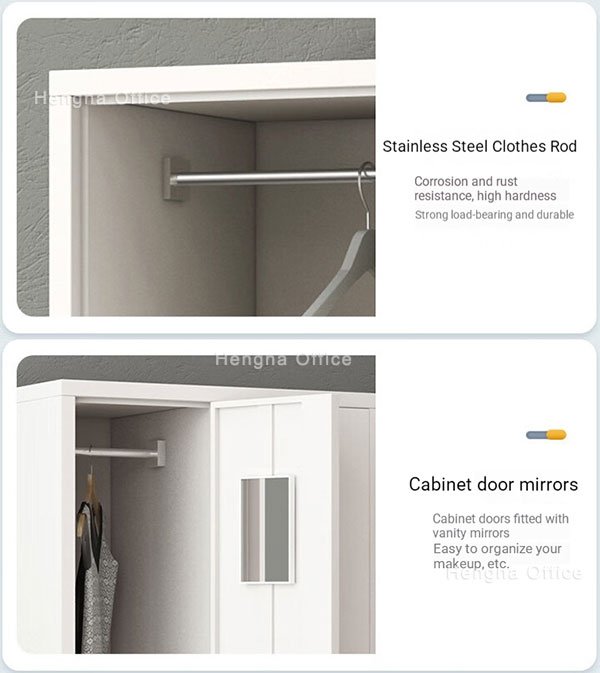
| Optional | Number plate / name tag slot / interior door mirror |
What Makes This Locker Different
Cold rolled steel — we’ve seen hot rolled cabinets rust through in 18 months
A factory changing room is tougher on lockers than a school dormitory. Humidity is higher, workers come off the production line sweating, wet uniforms get stuffed inside. Whether a locker lasts comes down to material grade and surface treatment, not sheet thickness.
These cabinets use cold rolled steel, not the cheaper hot rolled alternative. We’ve seen garment factories in East Africa install hot rolled lockers — within 18 months the doors started rusting from the bottom edges, rust water running down the door seams onto clothes. The factory manager had to re-bid the whole project. Hot rolled steel has a rough surface that powder coating can’t bond to properly. In a humid changing room, the coating peels at the edges and rust eats in from there. Cold rolled steel gives you a smooth surface. Powder coating bonds properly and lasts 6-8 years without peeling.
Dimensional accuracy matters too. When you order 50 or 100 units for a factory, they all need to line up in a row. Hot rolled steel has loose tolerances — you end up with uneven door gaps that look like a mismatch. Cold rolled steel holds tight tolerances. Doors line up, gaps are even, and the installation looks like a professional job.
Load bearing is another practical issue. Workers put their uniforms, safety boots, helmets, and lunch bags in one compartment — it adds up. Cold rolled steel shelves support 25 kg per compartment. Hot rolled shelves manage less than half that before they start sagging in the middle.
KD flat pack — the shipping savings alone can cover your next batch
Shipping a fully assembled locker typically eats up 30-45% of the total project cost. KD flat pack brings that down to 15-20%.
A standard 40HQ container holds under 250 fully assembled lockers. Flat packed, it holds over 800. When you’re shipping by volume, that’s a 3x difference in per-unit freight cost. For a factory project of 50 to 200 units, the math speaks for itself.
Each unit ships as flat stacked panels — side panels, doors, top and bottom boards, back panel, shelves — wrapped in moisture-proof film, packed in 5-layer corrugated cartons with hard corner protectors. Sealed against container condensation during sea freight. Arrives clean with no rust.
On-site assembly doesn’t require specialized crews. Two people with a Phillips screwdriver can put one unit together in about 40 minutes. Each flat-packed module weighs 15-20 kg — one person can carry it up stairs without an elevator. For our customers in East Africa and Southeast Asia, where professional installation teams are rare, KD flat pack means they can hire two general workers and get the job done. We provide an installation video that works offline (save it to a phone) plus printed instructions in the box.
Locks and hardware — the small details factory buyers tend to overlook
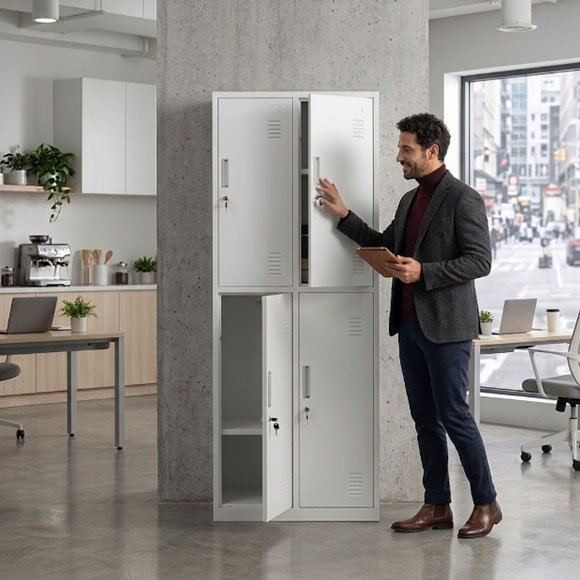
Each compartment has its own brass-core key lock. Brass cylinders wear 3-4 times longer than iron ones. Workers unlock their lockers 3-5 times a day. An iron lock starts catching after 1-2 years. A brass one still turns smoothly at year 4 or 5. Cross-key probability is extremely low — across hundreds of units with thousands of locks, the chance of matching keys is negligible.
Every compartment has a stainless steel hanging rod rated for 20 kg. Grade 304 stainless, passed 72-hour salt spray testing with zero rust. In humid factory conditions, iron rods start rusting within six months. Rust water drips down onto clothes below, and those stains don’t wash out. Workers notice — and they will complain.
Door vents allow continuous airflow through upper and lower compartments. Wet work uniforms air out instead of trapping moisture, so opening a locker doesn’t hit you with that sour smell.
Aluminum alloy recessed handles with anodized finish. Won’t discolor or oxidize. Edge chamfers so you don’t catch a shirt or scrape your hand. No exposed iron handles that rust and snag people walking past.
Powder coating
Steel goes through degreasing, acid washing, phosphating, drying, electrostatic coating, and curing before final inspection. Coating thickness: 60-80μm. Passes 2H pencil hardness — daily bumps and scrapes won’t expose bare metal. 48-hour moisture resistance test with no blistering or peeling.
Where It Works — and Where It Doesn’t
Good fit:
- Factory employee changing rooms (garment factories, electronics assembly, food processing plants)
- Industrial park developments — uniform configuration across multiple facilities
- Warehouse and logistics center changing areas
- Mining camp living quarters — KD flat pack makes sense for remote locations with difficult logistics
Not a fit for:
- Outdoor uncovered placement — no weather sealing; rain pooling on top seeps into the cabinet and rust starts from the inside. For outdoor use, choose stainless steel or a weatherproof canopy
- Poolside changing rooms — extreme humidity calls for stainless steel
- Storing valuables or sensitive instruments — upgrade to combination or electronic locks
Assembly
Each unit ships with: Side panels ×2, Doors ×4, Top board ×1, Bottom board ×1, Back panel ×1, Middle shelves ×3, Stainless steel hanging rods ×4, Screw kit + keys.
Tools needed: one Phillips screwdriver. Assembly time: about 40 minutes for one person.
For bulk orders: installation video (works offline) + printed diagram + missing-parts replacement guarantee.
FAQ
Q: How many units fit in one 40HQ container?
A single KD flat packed locker takes about 0.18 cubic meters. A 40HQ container has roughly 67 cubic meters of internal volume, so theoretically it could hold about 370 units. In practice you need room for loading access, mixed items, and protective packing — so a full 40HQ load runs around 800+ units based on actual shipping experience. Contact us for exact numbers if you’re mixing different models.
Q: Steel locker vs plastic locker for a factory — which is better?
Steel wins on strength and fire resistance by a mile. Plastic lockers are cheaper upfront, but in a factory with two-shift turnover, plastic units start cracking within two years. A steel locker lasts a decade without replacement — the total cost over time is lower. For factories with fire safety requirements, steel is mandatory.
Q: Does it need to be bolted to the wall?
No. The locker is stable on level flooring. If you’re concerned about tipping in heavy-use areas, anchor it with expansion bolts — the installation video covers this.
Q: Can I order a sample before placing a bulk order?
Yes. We can ship a trial quantity or mix several models in one small shipment. Contact us for details.
Q: Is the packaging moisture-proof for sea freight?
Three layers: moisture-proof PE film inner wrap + 5-layer corrugated carton + hard corner protectors. Sealed against container condensation during transit. Arrives clean and rust-free at your port.
Q: What if a key is lost?
Each compartment comes with 2 keys. Replacements available by key number.
Get a Quote
Every factory changing room project is different — some worry about dimensions, some about shipping costs, some about on-site assembly with no local crew. If you have a project, tell us what you need. We’ll put together a proposal and a quote. No obligation — just a conversation.
Contact us for a quote →