Ask a gym owner how many lockers they need and you get a number from the daily average. Run the same bank on a Saturday morning and that number is what makes the queue.
The gap between those two figures is the whole specification. This is how to close it, what twelve doors actually hold, and what has to be decided before anybody places an order.
The daily average is the wrong number
Take a club with 450 members, about 110 visits on a weekday, and 30% of visitors wanting a locker. Average stay inside the compartment: 75 minutes. The club is open 16 hours.
110 × 0.3 = 33 locker uses. 33 × 1.25 hours = 41 locker-hours. Divided by 16 hours open, that is under three compartments busy at any one moment.
Three. On the average day, three doors would cover it. Anybody who has stood in that changing room at 9am on a Saturday knows the average day does not exist.
Now the same club on Saturday. Ninety arrivals between nine and noon, the same 30% wanting storage, the same 75 minutes inside. Ninety × 0.3 = 27 uses. 27 × 1.25 = 34 locker-hours, divided by the three hours of the rush: eleven and a quarter compartments in use at once.
Twelve doors, and the queue never forms. Not because the average is twelve, but because the peak is. That is the number worth speccing, and it is usually three to four times the average.
Who opens a door, and for how long
Four groups use a gym locker bank, and they do not behave the same way. The mix decides how you split the doors, and whether one bank can serve all of them.
| Group | How long inside | What goes in | What they need |
|---|---|---|---|
| Regular members | 60 to 100 minutes | Training clothes, shoes, towel, phone | A door near the benches |
| Class attendees | 45 to 60 minutes | A bag of clothes, sometimes a laptop | Speed: class ends all at once |
| Trial visitors | One visit only | Coat, bag, shopping | A way in without holding a card |
| Coaches and staff | All day | Uniform, tools, a change of clothes | A taller compartment, and a fixed one |
The first two groups are the volume. The third is the one that breaks a card-only system, because a visitor with no membership cannot be issued a credential in ten seconds at a busy desk — unless the desk has a stack of temporary cards, which is a process decision rather than a product one.
Staff are the group most often forgotten. A coach who leaves a bag in a twelve-door bank every day will end up with a favourite door, and then a complaint when somebody else takes it. If the club has three coaches, reserve three compartments and mark the doors.
A membership card does most of the work already
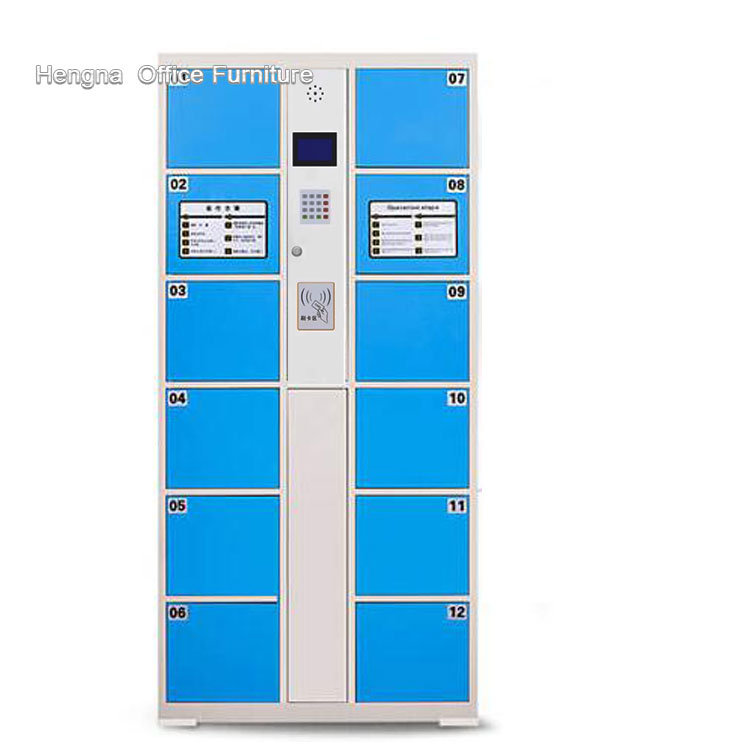
A card locker reads contactless IC. If the club already issues membership cards, there is no second account, no app, and no registration queue on the first Monday after installation. The member taps the card they were carrying anyway.
The operational difference from a keyed bank shows up in two places.
- A lost card is an admin task. Deactivate it in the member record, issue a replacement, done. A lost key means a new cylinder, a new key, and a door out of service until somebody fits it.
- Leavers stop being a risk. A coach who resigns hands back a card that can be switched off in a minute. A key that walked out of the building is a lock change.
Two card types cause trouble, and both are worth checking before the order. Magnetic stripe cards are being retired in most markets and need a different reader. Phone-only access needs a different reader again. If the cards are contactless, post one physically to the supplier instead of describing it in an email — a reader that rejects the cards you already issue is an expensive discovery.
The card-versus-key argument in more detail, including the objections that come up in a facilities meeting, is set out in card lockers for malls and gyms. If the club has no card system at all and does not want one, mechanical key lockers store the same clothes for less, with the key-handling cost above.
What twelve doors physically hold
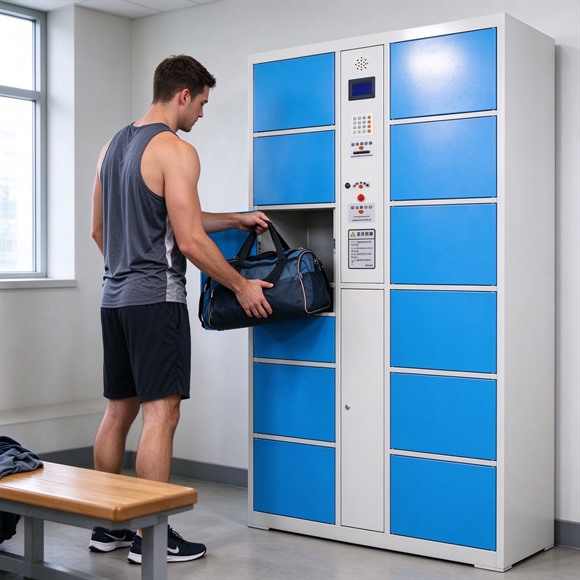
Twelve doors make one body: 1800 mm high, 850 mm wide, 460 mm deep, six rows of two. Each compartment is 270 mm wide, 300 mm high and 460 mm deep.
That is a pair of trainers, a folded tracksuit and a towel, with room for a small bag on top. It is not a rucksack compartment, and it is not a place to leave a laptop while training — anyone who brings one wants a taller door, which is why the layout can be split.
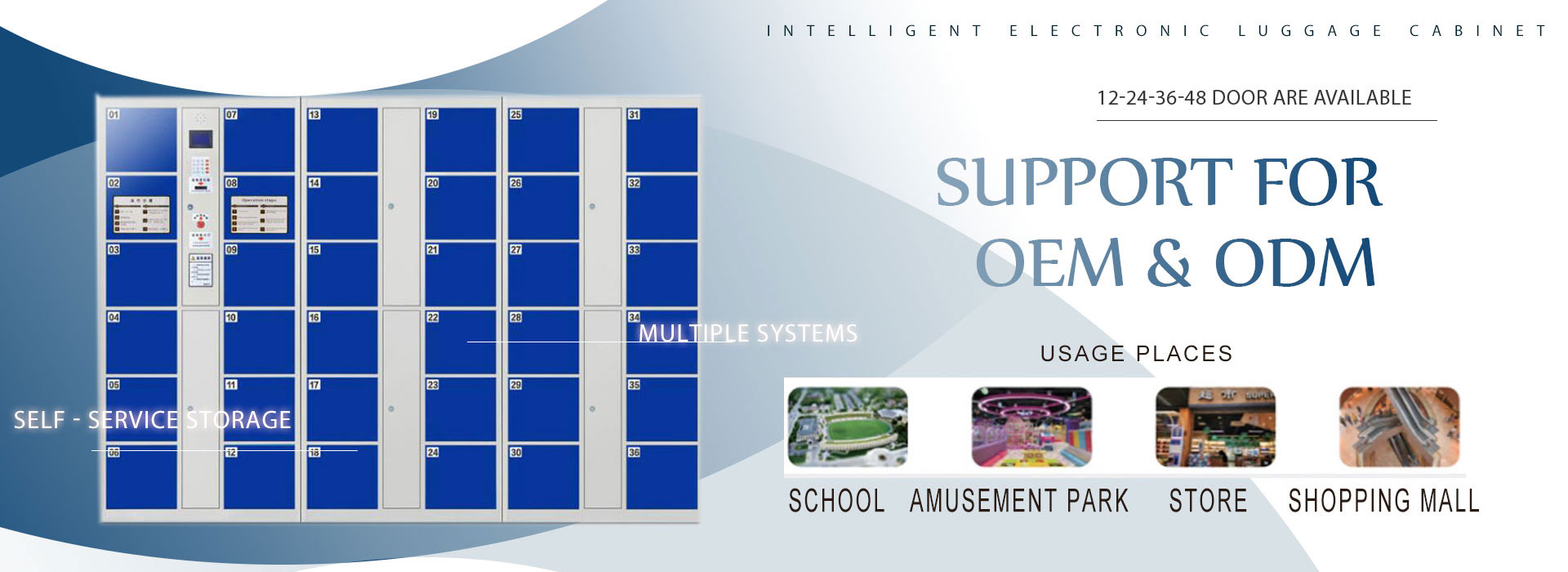
The bank grows in steps of twelve. Two bodies give 24 doors and 1700 mm of wall; four give 48 doors and 3400 mm, which is usually the point where the changing room wall runs out before the door count does. The full range and the door sizes are laid out under electronic locker systems.
Where it goes in the room
Placement decides the utilisation more than the door count does, and the rule is the same one that applies in malls: put it where the person has already decided they are not carrying the bag any further. In a gym that is the end of the bench run, before the showers, not beside reception.
Three practical conditions:
- A metre of clear floor in front of the doors. An open door plus somebody crouching in front of it is the space you actually need, not the 460 mm of cabinet depth.
- A wall that does not back onto the studio. Twelve doors are quiet; twenty-four doors opening and closing during a yoga class are not.
- A sightline from the desk or the coaches’ corner, so a stuck door gets noticed in minutes.
What can be changed, and what should not be
The customisable parts are the ones that make a bank look like it belongs in the room:
- Door colour. White body with sky blue, police blue, orange-red or fruit green doors. One colour per bank, not a mix, unless the brand palette really does have two.
- Door numbering and name plates. Number plates, a name tag slot, or a printed strip behind a clear holder on each door.
- Silk-screened logo on the control column, and custom packaging or manuals if the club is buying for several sites.
- Layout split. Part of the bank in standard doors, part in taller compartments for coaches and for anyone who brings a kit bag.
What should not be changed is the access logic halfway through a project. Deciding between card, code and barcode after the drawings are signed is how banks end up with a reader nobody’s card opens.
Power and installation
One earthed socket on the wall behind the cabinet. That is the whole requirement.
- A flat floor and a wall to stand against. No plinth, no fixing bolts.
- No network connection. The controller keeps its own record of which compartment is occupied.
- No dedicated circuit, no rewiring of the distribution board.
- Delivery rather than installation: the body arrives complete, gets positioned, plugged in and switched on.
If the club wants locker usage in the membership system, that is a conversation about the controller and the software, not about the cabinet. Ask it as a separate question and get the answer in writing.
Specifications
| Item | Value |
|---|---|
| Doors in this configuration | 12 |
| Body size | H1800 × W850 × D460 mm |
| Single door | W270 × H300 × D460 mm |
| Rows and columns | 6 rows × 2 columns, control column in the centre |
| Access | Contactless IC card, or a temporary card for visitors |
| Door colour | Sky blue, police blue, orange-red, fruit green on a white body |
| Body | Cold rolled steel, electrostatic powder coating |
| Power | One earthed socket |
| Network | Not required |
| Larger banks | 24 / 36 / 48 doors by adding bodies |
What to send before ordering
- The peak, not the average: arrivals in the busiest three hours, and the share of them wanting a locker.
- The card: post one, or confirm the type in writing.
- The room: a photo of the wall, the socket position, and how much floor is free in front of it.
- Whether visitor or trial cards are part of the plan, and who issues them.
Those four answers turn a price into a specification. The locker count, the finish and the delivery schedule come back with the quotation, and the arithmetic above is worth redoing with your own numbers before it does.
The alternative approach to the same problem is set out in 36-door barcode electronic lockers.