A scenic site does not have customers. It has arrivals. Three coaches pull in within twenty minutes, everybody wants to walk the trail without a bag, and then nothing happens for two hours.
Everything about specifying a locker bank for that pattern is different from a gym or an office: the peak is sharper, the stay is longer, and most of the people using it will never touch it again.
One coach, one bank
Work from the vehicle rather than the gate count. A coach carries around sixty people. On a site where visitors arrive with luggage — a mountain trail, a lake, a temple complex — roughly 70% of them will want to leave something behind.
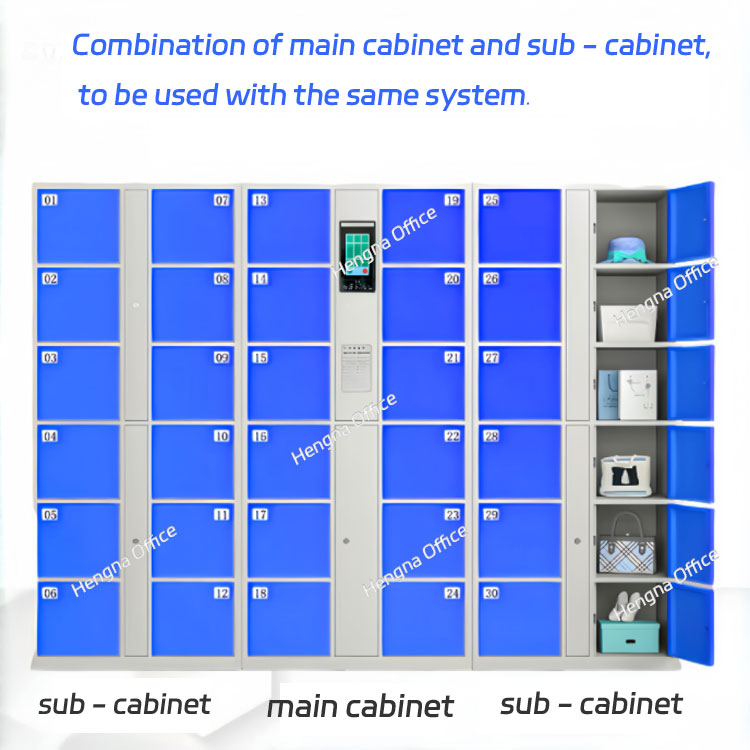
Sixty people × 0.7 = 42 items. Forty-eight doors, which is four bodies at 3400 mm of wall, absorbs that with room to spare — and the same bank serves the next coach twenty minutes later, because the queue at the counter takes longer than the deposits.
That is the number to plan around: one 48-door bank per coach load. If the site runs three coaches at once, it needs either three banks or somebody at the gate staggering arrivals, and the second option costs nothing except a sign and a radio.
The stay is hours, not minutes
This is where scenic sites break the usual arithmetic. In a gym the average stay inside a compartment is about 75 minutes, so the same door turns over several times a morning. On a trail it is three to five hours, and on a lake or a beach it can be all day.
Plan doors against items, not against uses. A 42-item coach load occupies 42 doors for half a day, and no amount of queue management makes those doors available to the next group before the first one comes back. The turnover rate on a scenic site is roughly a fifth of a gym’s.
What actually goes into a locker at a scenic site
- Day packs and camera bags. The core case, and the one a 270 × 300 mm door fits perfectly.
- Roller cases. A 24-inch case will not go through a standard door. Sites with coach parties need either a run of taller compartments or a staffed luggage room alongside the bank — deciding which is better done before the order, because it changes the body configuration.
- Umbrellas and wet coats. Real on a trail, and the reason a bank with louvred vents matters more here than in an office.
- Pushchairs. They do not fit. Neither do they fit anywhere else, so the site ends up with a corner of abandoned pushchairs unless somebody plans a bay for them.
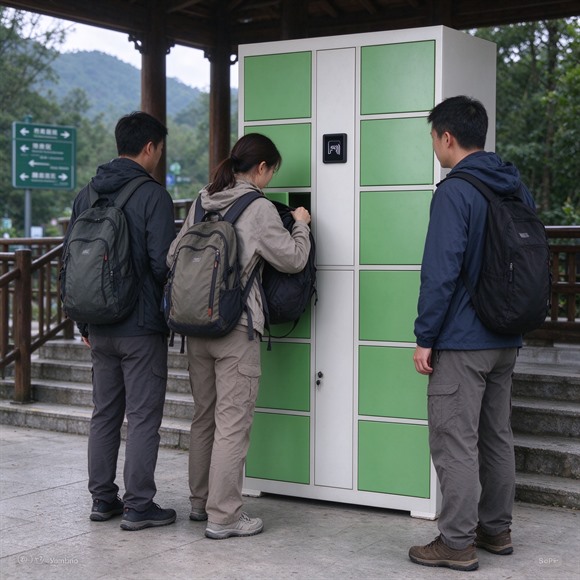
Placement: outside the gate, not inside it
Put the bank where the visitor still has a choice. That is the ticket hall, the bus drop-off, or the foot of the cable car — not the far side of a turnstile they cannot re-enter without paying again.
Two conditions specific to outdoor sites:
- A canopy or an indoor position. The cabinet is powder coated steel, but a bank in direct rain has water running down the doors and puddles in front of it, and visitors will not kneel in that.
- A sightline from a staffed point. Not for security theatre — because the person who cannot work the screen needs a human within thirty seconds, and on a scenic site that person is usually the ticket clerk.
Nobody uses it twice
A gym member learns the cabinet over a month. A visitor gets one attempt, in the sun, holding a bag, with a queue behind them.
That has a design consequence: the operation has to finish in about fifteen seconds, and the instruction has to be a picture rather than a paragraph. Paper slip with a barcode, a numeric code and the compartment number printed large — the model most public venues settle on — is set out in barcode storage cabinets.
It also means the failure modes get exercised daily rather than weekly. Slips get wet, codes get typed wrong, and somebody always walks away with the door ajar. Staff need the override routine before the first coach, not after the first complaint.
Power, weather and the queue
One earthed socket behind the cabinet, and a flat floor to stand it on. No network connection is required — the controller keeps its own record of which compartment is occupied, which is the reason a site with no IT support can still run one.
If the site wants to charge visitors for storage, that is a separate module and a separate conversation; the cabinet itself does not need a payment terminal to open a door.
Who runs it, and what happens at the gate
On a scenic site the bank is usually looked after by the ticket office, which means the person responsible for it is also selling entry, answering the phone and directing coaches. Any routine that takes more than a minute will not survive the first busy weekend.
- Morning. Check the printer roll and open the bank. Two minutes.
- During the day. Deal with the guest who cannot read the slip. That is the only recurring event, and it is a two-minute job if the management code is in the drawer.
- Evening. Clear any compartment left open, and bag anything left inside with the date on it.
- Weekly. Count what is in lost property against the compartment log. On a scenic site this is the point where abandoned bags start to accumulate.
A site that cannot answer who does those four things should not install a bank yet. The cabinet is the easy half.
Free, deposit, or paid — it changes the door count
How the site charges decides how long a bag sits inside, and that decides how many doors are needed.
- Free. Convenient, and the turnover is the worst. A bag stays all day because there is no reason to come back, so the doors do not recycle between coaches.
- Deposit returned on collection. Turnover is highest of the three, and the simplest to operate without staff involvement.
- Paid by the hour. Needs a payment terminal, a refund process and somebody to handle the disputes. Justified at large attractions, overkill at a small one.
Each step up in charging reduces the number of doors you need for the same coach load, because the bags come out sooner. It is worth deciding the model before the door count is drawn, not after.
Specifications
| Item | Value |
|---|---|
| Doors | 12 / 24 / 36 / 48, in bodies of 12 |
| Body size | H1800 × W850 × D460 mm per body |
| Single door | W270 × H300 × D460 mm |
| Colours | White body with sky blue, police blue, orange-red or fruit green doors |
| Access | Printed slip with barcode and numeric code |
| Power | One earthed socket |
| Network | Not required |
| Placement | Indoor or under canopy, against a wall |
What to send before the quote
- How many coaches or cars arrive in the busiest hour, and whether visitors carry luggage.
- The longest typical stay, since that sets the door count more than the arrival figure.
- A photo of the spot: wall, socket, and how much covered floor is free in front of it.
- Whether roller cases are common — if they are, the door mix changes.
Those four answers decide whether the site needs one 48-door bank or three 12-door ones, and that is a cost difference worth getting right at the drawing stage.
The dwell time public buildings bring is covered in 24-door self-service electronic lockers, with the high-turnover case in electronic luggage lockers.