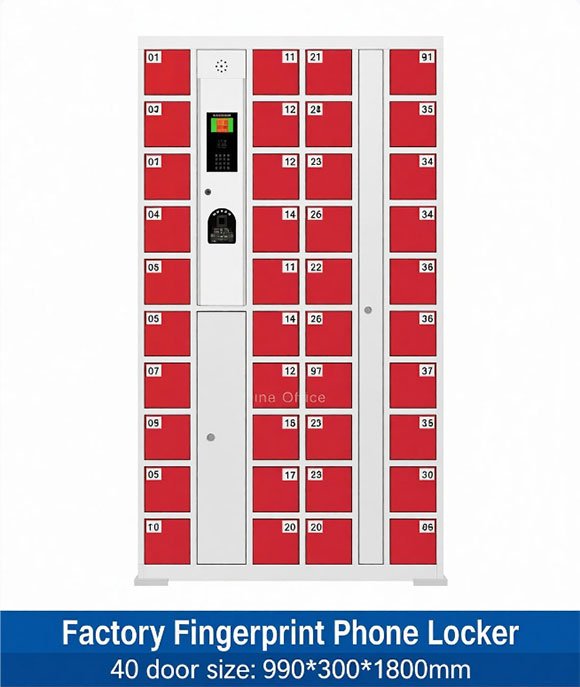
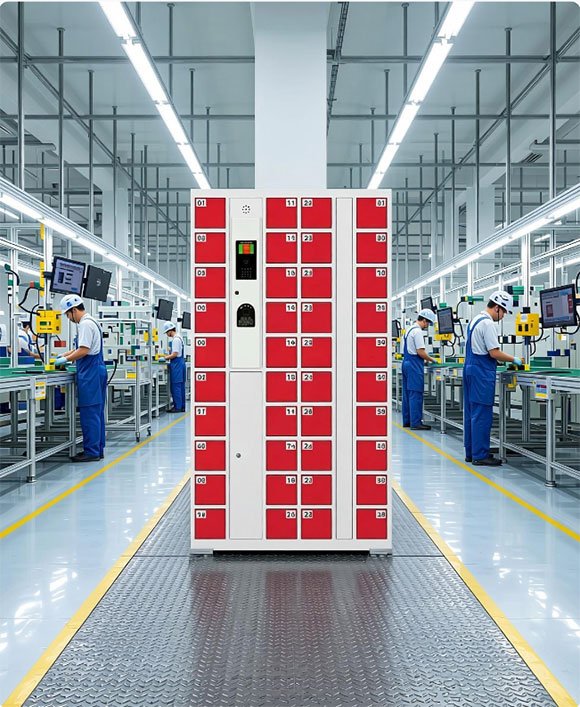
A factory that runs a no-phone policy has one question to answer before the first shift: where do 200 phones go at 7 a.m.? The answer determines whether the policy survives its first week. Without a secure, fast storage point, phones end up hidden in toolboxes, lunch bags, and bathroom breaks—exactly where the policy said they should not be.Fingerprint phone lockers answer that question. An employee walks in, touches the scanner, drops the phone in the assigned door, and is at the workstation in seconds. No keys, no cards, no PIN to share, and no line that makes the morning shift late.
Why Factories Choose Fingerprint Over Keys and Cards
Factory floors are hard on access systems. Keys get lost in coveralls. Cards get bent in pockets, left in lockers, or loaned to a coworker. PINs get shared by shift handover. Fingerprint access removes all of it: the key is attached to the employee, cannot be shared, and works with dirty hands after the reader has a quick wipe.The reader itself matters more than the rest of the cabinet. Dust and oil are constant on a production floor. A factory-grade unit uses a sealed optical reader with a raised bezel, so a finger can be read through a layer of metal dust. Cheap readers fail exactly when the shift is busiest. When comparing suppliers, ask about the reader first, the door count second.
Sizing: Doors Follow the Headcount, Not the Policy
The door count follows the largest shift. A factory with 120 workers on the floor at peak needs at least 40 to 60 doors if the locker bank is shared by shift rotation—phones from the outgoing shift are collected as the incoming shift stores theirs, so the bank is never fully occupied for long. A factory with 500 workers usually runs two banks at opposite entrances rather than one giant unit, because a 300-meter walk to a single bank adds minutes to every shift change.Compartment depth matters too. A phone plus a wallet plus a pack of cigarettes needs a compartment around 200mm deep. If employees store tablets or tools, order a mix with a row of larger doors. The mix is set at the factory, so the order sheet should match what actually goes in the doors, not a guess.
Where the Bank Goes
Placement decides adoption. The bank goes between the entrance turnstiles and the production floor—on the route employees already walk. Putting it in the locker room is the common mistake: employees change fast and forget the phone, then carry it onto the floor. Entrance placement also lets the security desk see the bank, which solves disputes before they start.The unit needs a grounded 110V outlet within 6 feet and a flat, level spot. It runs standalone—no network, no server, no IT tickets. The control board stores fingerprints locally and logs every open event with a time stamp.
The First Week Rollout
Rollout takes one week when it is planned. Day one: HR enrolls the day shift, ten seconds per employee, during the morning line-up. Day two: the night shift. Day three: floaters, visitors and contractors get temporary enrollments. By day five, the security desk knows the master override and the maintenance crew knows the reader wipe-down routine. Factories that skip enrollment planning and let employees self-register on the first morning end up with a line at the machine and a grumpy first shift—the machine is not the bottleneck, the schedule is.
Visitor and Contractor Phones
Visitors and contractors are the loophole in most no-phone policies. A visitor badge without a phone rule is half a rule. The locker bank closes it: security enrolls a temporary fingerprint or issues a one-day barcode ticket at the gate, and the phone stays at the entrance with everyone else’s. Temporary enrollments expire automatically at the end of the day, so there is no cleanup step for security.
Shift Handover and Shared Doors
Shared-door operation is where fingerprint access pays off most. The same door can serve the day shift and the night shift without resetting anything: the system matches the fingerprint to the current enrollment. Employees who leave the company are removed from the system in under a minute—there is no key to chase down, no card to deactivate, and no lock to re-key.For factories that prefer assigned doors, the system supports that too: an administrator enrolls each employee to a fixed door, and the reader unlocks only that door. Both modes run on the same hardware, so the choice can change later without replacing the bank.
Steel and Dust: Built for the Floor
A production floor is dust, oil, and impact. The cabinet body should be 0.8mm cold-rolled steel with a powder-coated finish. Forklift traffic clips corners; carts scrape bases; the unit has to look presentable at year three, not just survive. Raised feet keep mop water away from the steel, and the powder coat wipes clean with the same rag the maintenance crew uses on everything else.Dust is the quiet enemy of the electronics. The reader bezel needs a dry wipe once per shift in dusty plants, and the unit should be ordered with a sealed control board. These are small items on the spec sheet and the first things that fail if ignored.
Fingerprint vs Barcode vs RFID: The Cost Logic
Fingerprint is the highest-access tier: nothing to carry, nothing to lose, per-door cost a step above barcode. Barcode tickets are the lowest-cost option and suit factories with high contractor turnover, because temporary tickets expire on their own. RFID cards sit in the middle—fast, but the card is another thing to carry, and lost cards become a security-desk chore. Most factories settle on fingerprint for the main bank and barcode for visitor doors. The hardware supports mixing types, so the decision can be per entrance, not per factory.
Maintenance: A Five-Minute Daily Routine
The daily routine is five minutes: wipe the reader bezel with a dry cloth, check the panel for error lights, and glance at the log for any door that did not close properly. Weekly, the maintenance crew checks the power cord route and the leveling feet. Monthly, the office reviews the enrollment list and removes anyone who left. That is the entire maintenance program. There are no keys to track, no locks to lubricate, and no consumables beyond a dry cloth—which is the point of ordering biometric access in the first place.
Five Questions to Ask a Supplier
Is the fingerprint reader sealed? Optical, raised bezel, dust-resistant—test it with a dusty finger.
How many fingerprints does the board store? Enough for the largest shift plus turnover.
Can doors be assigned or shared per shift? The factory should support both modes.
Control board warranty? Three years is standard.
Lead time? Factory-direct units ship in 15 to 25 days plus ocean freight.
At Luoyang Hengna, we build fingerprint phone lockers for factories in 40, 50 and 60 door versions, with sealed optical readers, local fingerprint storage, and a three-year control board warranty. Tell us your largest shift, your entrance layout, and whether doors will be assigned or shared. We will size the bank and quote it within one working day.