With the widespread use of smartphones on campuses, managing student phone usage during school hours has become a common challenge for educators worldwide. From preventing exam cheating to reducing classroom distractions and ensuring the safety of personal belongings, more and more schools are realizing that phone lockers are no longer a “nice-to-have” facility, but a “must-have” for modern campus management.
So, among the various technologies available—fingerprint, RFID card, and barcode—which type of phone locker is best suited for a school environment? This article provides an in-depth analysis and recommends the barcode phone locker, the ideal solution for educational settings.
- 1. Why Do Schools Urgently Need Phone Lockers?
- 2. Comparison of Main Technologies: Why Barcode is the Winner
- 3. How Does a Barcode Phone Locker Solve Real Campus Problems?
- 4. How Does the Barcode System Ensure Security and Order?
- 5. Beyond Schools: The Versatility of the 50-Door Barcode Locker
- 6. Frequently Asked Questions (FAQ)
- 7. Choosing a Smarter Solution for Schools
1. Why Do Schools Urgently Need Phone Lockers?
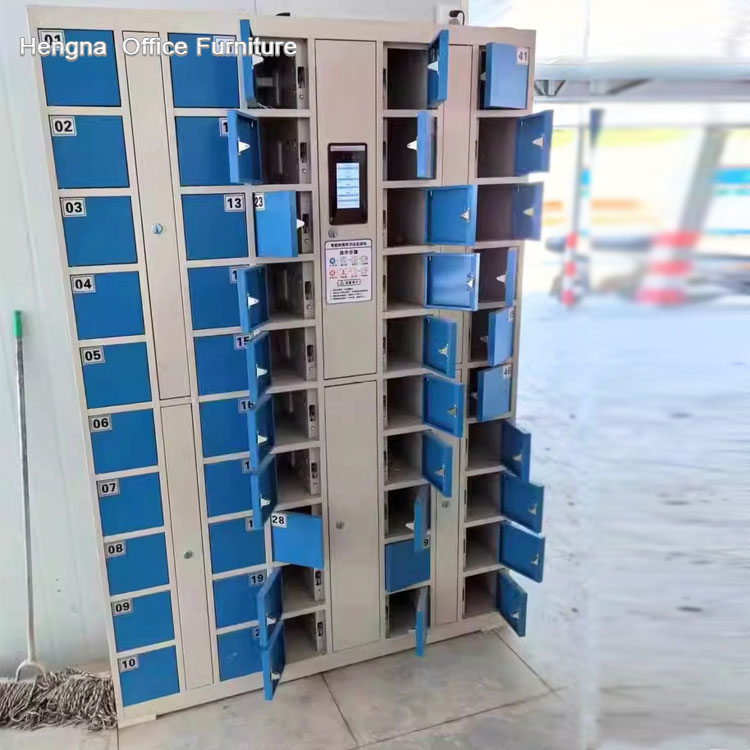
During exams, phone-based cheating is a persistent problem. Even if a student has no intention of cheating, having a phone in the exam hall can create distrust among invigilators. In daily teaching, phones disrupt classroom order and negatively impact learning efficiency.
More importantly, when students store their phones together, safety and privacy become paramount. Simply piling phones on a teacher’s desk or in a cardboard box creates significant management risks if phones are lost, misplaced, or damaged. A dedicated phone locker with individual compartments, traceability, and ease of use is essential to solving these issues.
2. Comparison of Main Technologies: Why Barcode is the Winner
Currently, the main types of phone lockers on the market use three identification methods: fingerprint, RFID card, and infrared barcode. Let’s examine their performance in a school setting:
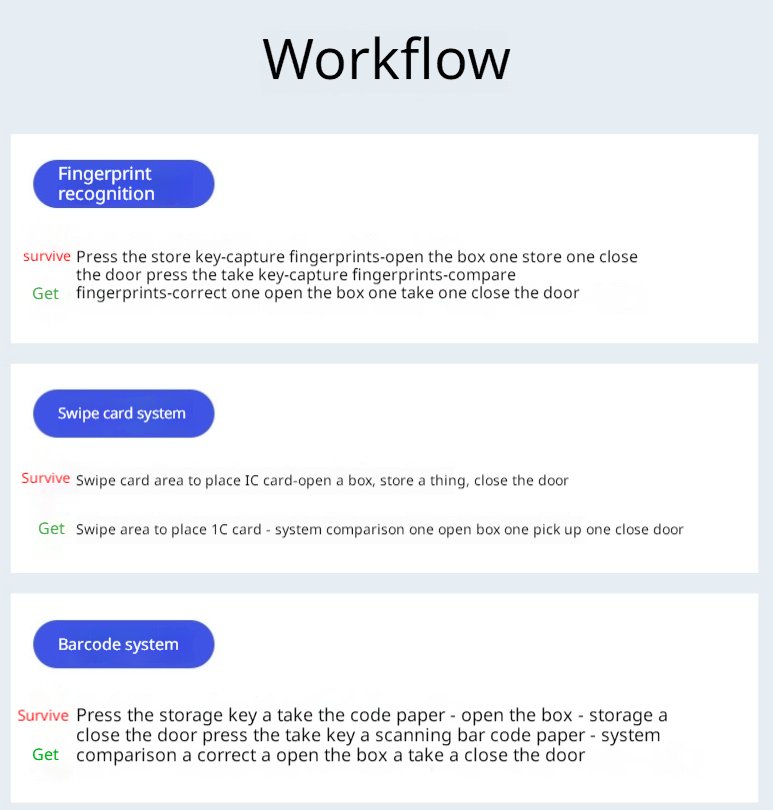
1. Fingerprint System
- Advantages: Unique biometric identification, high security, no need to carry an extra item.
- Disadvantages: Not suitable for schools. Students’ fingers can be sweaty or have peeling skin, leading to unstable recognition rates; during exam periods, large crowds cause long queues; the equipment is costly and complex to maintain.
2. RFID Card System (IC Card)
- Advantages: Fast recognition, simple operation.
- Disadvantages: Students must carry and keep track of an IC card, creating the hassle of losing or forgetting the card. For schools with many day students and high turnover, card issuance and management are costly and logistically challenging.
3. Barcode System
- Advantages:
- Ready to use, no need to pre-issue cards. Students press a button to get a barcode slip, and the system automatically assigns an empty compartment and prints the slip.
- Intuitive operation. To retrieve items, students simply scan the barcode slip; the system verifies it and opens the correct compartment. No learning curve.
- Hygienic and convenient. Touchless operation avoids the cross-contact associated with fingerprint readers.
- Moderate cost, stable and reliable. Thermal printing technology is mature with a low failure rate, making it ideal for high-frequency, short-term storage scenarios in schools.
- Perfect for exams and daily use. The barcode slip can be used once and discarded, greatly reducing the school’s administrative burden.
From this comparison, it’s clear that the barcode phone locker aligns better with school needs in terms of convenience, management cost, and scenario suitability.
3. How Does a Barcode Phone Locker Solve Real Campus Problems?
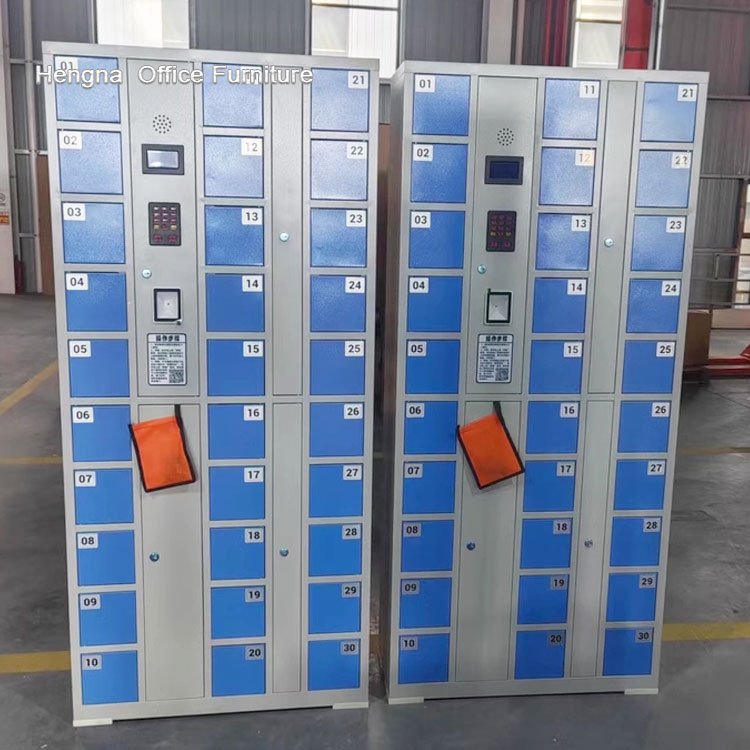
Take a typical 50-door barcode phone locker as an example. Its design details reflect a deep understanding of the campus environment:
- Reasonable Size, Ample Capacity
With dimensions of 1800mm (H) x 1260mm (W) x 300mm (D) and 50 individual compartments, it can accommodate a standard class size or exam group. Its shallow depth doesn’t take up excessive hallway space, making it suitable for placement outside classrooms, at exam entrances, or in school hallways. - Rich Color Options, Customizable Appearance
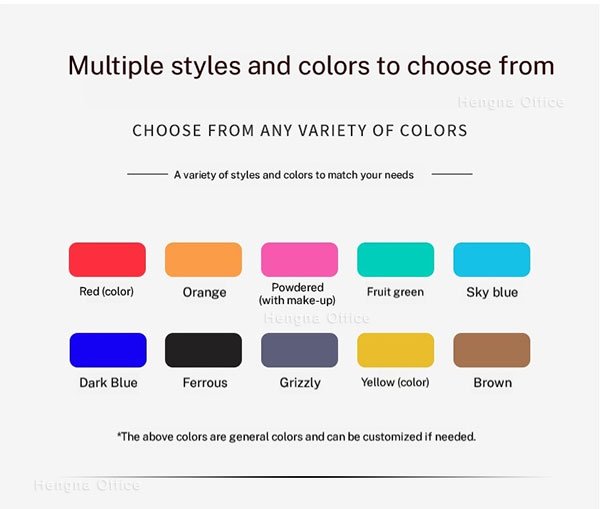
Schools can choose from a variety of standard colors like pink, orange, sky blue, black, rose red, grass green, dark blue, white, red, apple green, coffee, and gray to match the campus aesthetic. Color zoning can also help identify different grades or classes quickly. Additionally, the lockers support custom logo printing and size adjustments to perfectly fit the school’s branding and spatial layout. - Extremely Simple Operation, Zero Training Required
The standard operating process is straightforward:- To Store: Press “Store” → Get barcode slip → Compartment door opens → Place phone inside → Close the door.
- To Retrieve: Press “Retrieve” → Scan barcode slip → System verification → Compartment door opens → Take out phone → Close the door.
- Supports Concurrent Users, No Congestion
The 50-door design allows multiple people to use the locker simultaneously. The system uses a “real-time door status monitoring” mechanism to intelligently avoid conflicts, ensuring smooth operation during peak periods like exam entry or breaks.
4. How Does the Barcode System Ensure Security and Order?
Some school administrators might worry: what if a barcode slip is lost or picked up by someone else? Mature barcode locker systems incorporate robust hardware and software security features:
- One barcode, one compartment, single use. The barcode becomes invalid immediately after retrieval, preventing re-use.
- Traceable access records. The system logs the compartment, time, and operation sequence for each use, facilitating audits if needed.
- Thermal security paper makes the barcode slips difficult to tamper with or copy.
- Emergency override. Administrators are equipped with mechanical keys or a master card to handle situations like a student losing their barcode slip.
Compared to fingerprint lockers, where recognition failures can lock students out of their belongings, or card lockers, where lost cards cause disputes, the barcode system centralizes risk in a manageable paper credential. This creates a clearer management logic and simplifies on-site issue resolution.
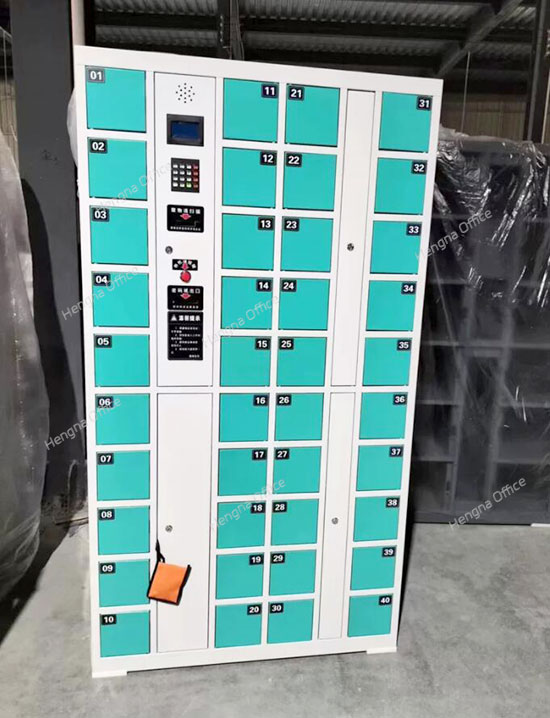
5. Beyond Schools: The Versatility of the 50-Door Barcode Locker
While this article focuses on school scenarios, the 50-door barcode locker is highly versatile and widely used in other settings:
- Factory Workshops: Employees store phones before entering production areas, ensuring safety and confidentiality.
- School Exam Halls: Efficiently manages candidates’ phones during exams, eliminating cheating risks.
- Exhibition Venues: Provides temporary storage for exhibitors and visitors, enhancing the visitor experience.
- Hospital Visitor Areas: Allows visitors to store belongings, maintaining order in wards.
- Logistics & Warehousing Centers: Staff store personal electronic devices before entering restricted areas to prevent data security risks.
- Entertainment Venues (KTVs, Internet Cafes): Offers convenient storage for customers’ valuables, reducing disputes.
One piece of equipment serves multiple industries and scenarios, providing long-term value from a single investment.
6. Frequently Asked Questions (FAQ)
Q1: What specific places is the 50-door barcode phone locker suitable for?
A: It is suitable for locations that require centralized phone management, such as factory workshops, school exam halls, exhibition venues, hospital visitor areas, logistics and warehousing centers, and entertainment venues (KTVs, internet cafes).
Q2: What color options are available for the locker? Can the appearance be customized?
A: We offer standard colors (including over 10 options like blue, black, white, etc.). Customization services such as logo printing and size adjustments are also available to meet the specific needs of different scenarios.
Q3: Can multiple people use the locker at the same time? Are there any concurrency limitations?
A: Yes, the locker supports simultaneous operation by multiple users. The system uses a “real-time door status monitoring” mechanism to intelligently avoid conflicts, and the 50-door design comfortably handles peak usage periods.
7. Choosing a Smarter Solution for Schools
Managing phones isn’t about a blanket ban on student device usage; it’s about using scientific management tools to help students build a sense of discipline and self-regulation. Among the three main technologies—fingerprint, RFID card, and barcode—the barcode phone locker stands out for its advantages: no need to issue cards, intuitive operation, high reliability, and low management costs. It is increasingly the preferred choice for elementary schools, high schools, and vocational institutions.
If your school is seeking an efficient solution for exam organization, classroom management, or student phone storage, we highly recommend considering the 50-door barcode phone locker with its infrared barcode system. It is more than just a piece of equipment; it is a management mechanism that gives schools peace of mind, reassures parents, and helps students develop good habits.
Let phones be stored orderly, and let education return to focus—starting with a barcode phone locker.